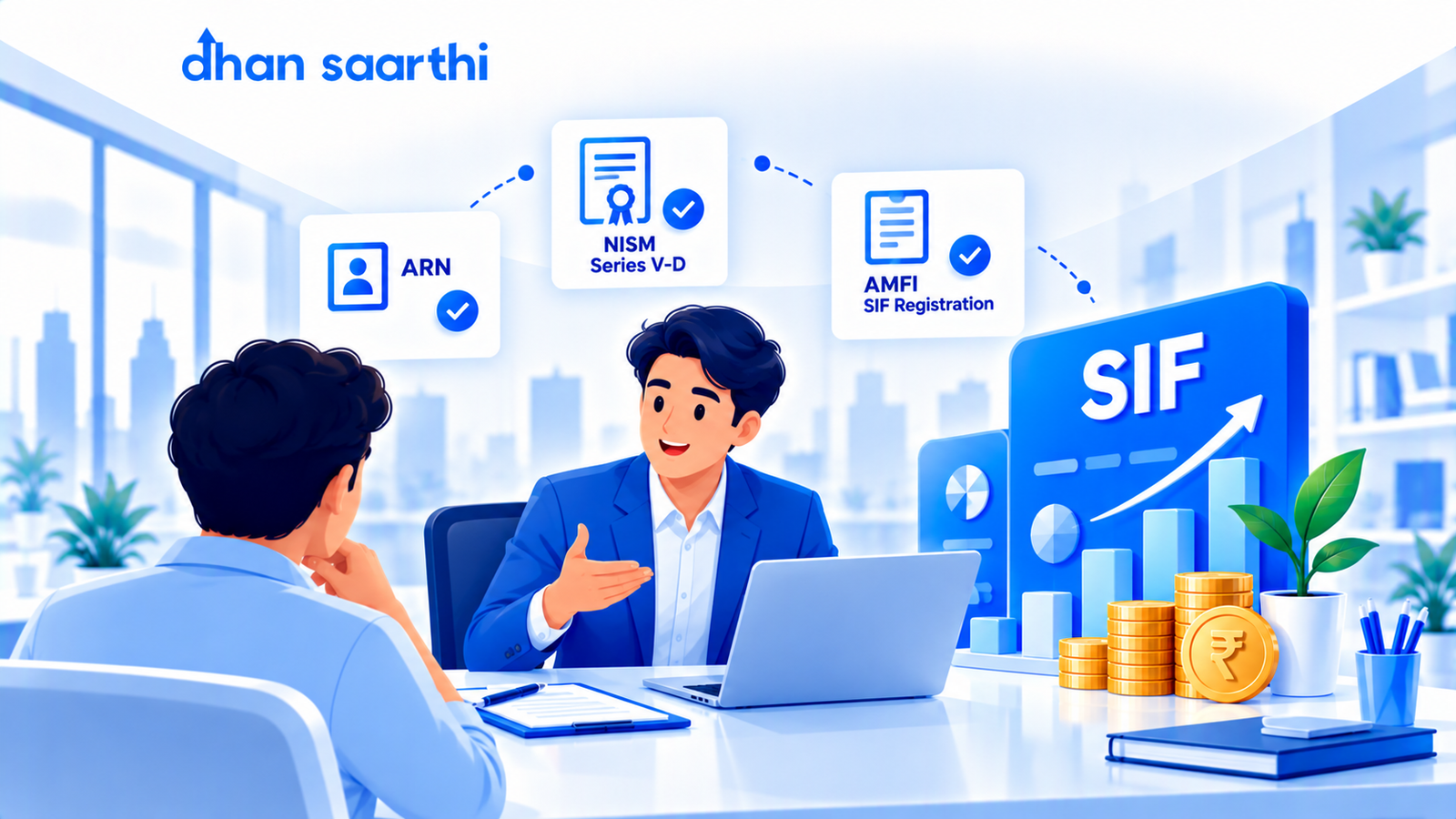
Quick answer: To sell SIFs as a distributor, you need a valid ARN, the NISM Series V-D certification and AMFI registration in the SIF category. Then empanel with the AMC (or join a platform that already is) and pitch SIFs only to clients who can put at least ₹10 lakh into a SIF without it being too large a share of their portfolio. You earn trail commission, as with mutual funds. Explain the risk, the ₹10 lakh rule and the redemption terms before every sale.
| Key fact | Value |
|---|---|
| Who can sell SIFs | A mutual fund distributor with a valid ARN, NISM Series V-D and AMFI SIF registration (SEBI FAQ C1, C2) |
| Certification | NISM Series V-D. It covers mutual funds too, so you do not need V-A separately |
| Already hold Series XIII? | Valid if obtained on or before 21 September 2026, with a valid V-A, until it expires |
| Minimum investment | ₹10 lakh per investor, counted at PAN level across all strategies of one SIF. Accredited investors exempt |
| How you are paid | Trail commission set by each AMC. AMFI rules for ARN holders apply to SIFs too |
| Average distributable TER | About 1.3% a year across SIF strategies (AMFI data via Cafemutual) |
| SIF industry size | About ₹38,000 crore AUM, 17 AMCs and 1.5 lakh+ folios (September 2026) |
| Where to find SIFs | Dhan Saarthi SIF explorer: browse, compare and add SIFs to client proposals |
All earnings figures in this article are illustrations with stated assumptions, not projections or promises.
What is a SIF, in one minute?
A Specialized Investment Fund (SIF) is a product run by a mutual fund AMC under SEBI's February 2025 framework. It sits between a mutual fund and a PMS. A SIF can use strategies a regular fund cannot, such as taking short positions through derivatives (unhedged short exposure is capped at 25% of net assets). But it keeps mutual fund–style regulation, NAV-based pricing, disclosures and taxation. Each SIF runs a separate brand from the AMC's mutual fund schemes.
For you, the useful way to see it is this:
| Mutual fund | SIF | PMS | |
|---|---|---|---|
| Minimum ticket | ₹100–₹5,000 | ₹10 lakh (PAN level) | ₹50 lakh |
| Strategy freedom | Limited; mostly long-only | Long-short with derivatives, within limits | Wide |
| Taxation | Fund-level; investor taxed on redemption | Same as mutual funds | Every trade taxed in investor's hands |
| Liquidity | Mostly daily | Daily to weekly or longer, by strategy | Varies |
| Regulator / wrapper | SEBI MF regulations | SEBI MF regulations (separate SIF brand) | SEBI PMS regulations |
| Who sells it | MFD with NISM V-A or V-D | MFD with NISM V-D + AMFI SIF registration | PMS distributor (NISM XXI-A) |
Short version for clients: a SIF is a PMS-style strategy in a mutual fund wrapper, at one-fifth of the PMS ticket. For the exam side, see our NISM 5D (Series V-D) exam guide.
Can a mutual fund distributor sell SIFs?
Yes. SEBI's SIF FAQs (22 September 2026) confirm that a mutual fund distributor can sell SIFs after clearing NISM Series V-D and registering with AMFI. The ARN must stay valid. What applies to you depends on where you start:
| Your situation | What you need to sell SIFs |
|---|---|
| New to distribution | Pass NISM V-D, then apply for ARN and SIF registration together on the AMFI portal |
| MFD with NISM V-A only | Pass NISM V-D, then add the SIF category on the AMFI portal |
| MFD with V-A + Series XIII (on or before 21 Sep 2026) | You can sell SIFs until the XIII certificate expires, if V-A also stays valid. Then move to V-D |
| Firm / non-individual ARN | Every ARN and EUIN on a regular-plan SIF application must hold valid V-D (SEBI FAQ C6) |
| RIA or channel partner | Existing AMC agreements can be extended to SIF with an addendum once V-D and AMFI registration are done (FAQ C7) |
If your ARN lapses, your SIF registration stops working with it. Set a reminder for the ARN renewal date and the V-D expiry (3 years from the exam date).
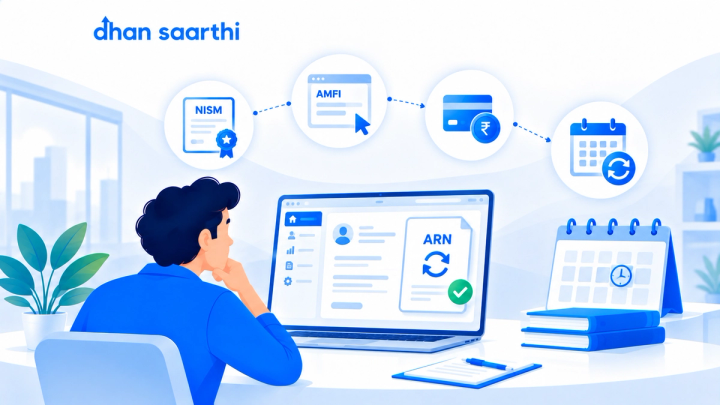
How to become a SIF distributor: 5 steps
Pass NISM Series V-D
150 questions, 3 hours, 60% to pass, 10% negative marking, ₹3,000 fee. It covers mutual funds, equity derivatives and interest rate derivatives. Budget 3–4 weeks of study if derivatives are new to you. Before you book, take Dhan Saarthi's free NISM V-D mock test: a full-length paper with the real pattern and negative marking, so you see your score and weak chapters before exam day.
Register for the SIF category with AMFI
Apply on the AMFI portal (run by CAMS) with your V-D certificate and ARN. Industry sources report ₹5,000 to register and ₹3,000 to renew for individuals under V-D. Confirm the current fee on the portal.
Empanel with SIF AMCs, or use a platform
Each AMC needs an empanelment form or SIF addendum. With 17 AMCs running SIFs, that is a lot of paperwork. A distribution platform gives you access in one onboarding.
Learn the strategies you will sell
Read each strategy's ISID: objective, derivatives use, risk band, redemption frequency, notice period and exit load. Start with 2–3 strategies you can explain well, not all 30+.
Build your client shortlist
Filter your book for clients who can invest ₹10 lakh in a SIF and still keep it a small slice of their portfolio. The next section shows how.
Which SIF strategies can you sell?
SEBI allows seven strategy types across three groups. Debt-oriented strategies had not launched as of September 2026; hybrid strategies held about 69% of SIF assets.
| Group | Strategy types | Minimum redemption frequency | Typical client fit |
|---|---|---|---|
| Equity | Equity Long-Short; Equity Ex-Top 100 Long-Short; Sector Rotation Long-Short | Daily or less often | Equity-heavy clients wanting a different return pattern from their large-cap and flexi-cap funds |
| Hybrid | Active Asset Allocator Long-Short; Hybrid Long-Short | Twice a week or less often | Clients wanting lower volatility than equity, or comparing against arbitrage and balanced advantage funds |
| Debt | Debt Long-Short; Sectoral Debt Long-Short | Once a week or less often (interval) | Fixed-income clients who accept limited liquidity |
Redemption frequency per SEBI SIF FAQ B45. Each strategy states its own frequency and notice period in its ISID.
Each strategy carries a risk band from 1 to 5, reviewed monthly and shown on the AMC's website. Use it in your conversation, but do not let it replace your own suitability check.
Who should you sell SIFs to?
The ₹10 lakh minimum does half the filtering for you. The other half is fit. A practical rule many distributors use: keep a single SIF at no more than 10–20% of a client's investable portfolio. That points to clients with roughly ₹50 lakh or more invested.
Good fits
- ✓ Large mutual fund clients with ₹50 lakh+ across equity funds, who ask "what else is there?"
- ✓ PMS investors or prospects who like a strategy but not the ₹50 lakh ticket or per-trade taxation.
- ✓ Business owners and senior professionals with lumpsum events: bonus, ESOP sale, property sale, maturing FDs.
- ✓ Clients holding arbitrage or balanced advantage funds who may compare a hybrid long-short SIF on risk and return.
- ✓ NRI and HNI families already used to market-linked products and multi-year horizons (check AMC rules for NRIs).
Poor fits
- ✕ First-time investors, or anyone who has not lived through a market fall.
- ✕ Clients who would need to stretch, borrow or pool money to reach ₹10 lakh.
- ✕ Anyone who may need the money within 2–3 years, or needs daily liquidity from a weekly-redemption strategy.
- ✕ Clients who want guaranteed or FD-like returns. A long-short fund can still lose money.
How to pitch a SIF: a 5-step client conversation
Most top-ranking guides tell you to "educate the client". Here is what that looks like in a real meeting. SEBI's FAQ C10 lists what you must explain before any SIF investment; the steps below cover all of it.
Start from the portfolio, not the product
Review the client's current holdings first. Say why you are bringing up a SIF: "Your equity is all long-only and moves with the market. This strategy can hedge part of that."
Explain the strategy in one line
For example: "The fund buys stocks it likes and uses derivatives to bet against some it doesn't, up to 25% of the fund." Then show the risk band and the scenario analysis in the ISID.
Be upfront about the risks
SIFs are higher-risk than regular mutual funds. Derivatives can magnify losses, the track record is short (the first SIFs launched in 2025), and past returns of a new category say little.
Walk through the rules that surprise people
The ₹10 lakh PAN-level minimum and what happens on a breach; redemption frequency and notice period; fees, expense ratio and exit load.
Size it, then document it
Suggest an amount that fits the portfolio, not the maximum the client can afford. Record the risk profile, the reason for the recommendation and what you explained.
Tip: Bring a one-page comparison of the SIF against the client's current fund and a PMS option. Clients understand a side-by-side faster than a brochure. On Dhan Saarthi you can compare SIFs side by side with mutual funds and add them to the client proposal.
How to handle common client objections
| Client says | How to respond |
|---|---|
| "₹10 lakh is a lot to lock in." | It is not locked in: equity strategies can allow daily redemption. But the client should only invest money they can leave for 3–5 years. If ₹10 lakh feels large, the SIF is probably not right yet. |
| "Isn't this just a PMS?" | Similar strategy freedom, but a SIF is regulated like a mutual fund, has a ₹10 lakh ticket against ₹50 lakh, and is taxed like a mutual fund, not on every trade. |
| "Derivatives sound risky." | They can be. Show how the strategy uses them (hedging vs taking a view), the 25% cap on unhedged shorts, and the risk band. Do not play the risk down. |
| "What returns will I get?" | No one can promise returns. Show the strategy's objective and how it may behave in rising and falling markets. Avoid quoting a few months of past returns as a forecast. |
| "Why not just buy a mutual fund?" | For many clients, that is the right answer. A SIF is an addition for a specific job, not a replacement for their core funds. |
The ₹10 lakh rule: active and passive breach
The minimum is ₹10 lakh per investor, counted at PAN level across all strategies of the same SIF. Accredited investors are exempt. The rule bites in two ways:
| Type | What happens | What it means for you |
|---|---|---|
| Passive breach | Value falls below ₹10 lakh because of market movement | No action needed. Tell the client in advance that this is allowed |
| Active breach | The client redeems or switches out, taking the total below ₹10 lakh | Units in that SIF are frozen for debits and the client gets a notice period (reported as 30 days) to top up. Check the AMC's ISID for what follows |
Example: A client holds ₹12 lakh across two strategies of one SIF. A fall takes it to ₹9.5 lakh: passive breach, nothing happens. If instead the client redeems ₹3 lakh while the holding is at ₹12 lakh, the total drops to ₹9 lakh: an active breach. Before any partial redemption, check the client's PAN-level total.
SIF distributor commission: how much can you earn?
SEBI's FAQ C8 says each AMC sets the brokerage for its SIF strategies, and AMFI's circulars for ARN holders apply to SIF distributors too. In practice that means trail commission, paid from the regular plan's expense ratio, with no upfront payment. Across SIF strategies the average distributable TER (regular minus direct) is about 1.3%, mostly between 1.0% and 1.8%. Your actual trail is set in your empanelment with each AMC and is lower than the full gap.
| SIF assets you bring | Annual trail at 0.8% | Annual trail at 1.0% |
|---|---|---|
| ₹10 lakh (1 client) | ₹8,000 | ₹10,000 |
| ₹1 crore (about 8–10 clients) | ₹80,000 | ₹1 lakh |
| ₹5 crore | ₹4 lakh | ₹5 lakh |
| ₹10 crore | ₹8 lakh | ₹10 lakh |
Illustration only: assumes flat AUM and a constant trail rate, before GST and platform share. Actual rates vary by AMC and strategy.
Because every SIF ticket starts at ₹10 lakh, a handful of clients can add meaningful trail. But chase fit, not ticket size: one unsuitable sale that goes wrong can cost you a family's whole book. More on trail maths in our MFD commission guide.
Mistakes to avoid when selling SIFs
- Selling on recent returns. Most SIFs have under 18 months of history. Sell the strategy's job, not its last quarter.
- Treating SIF as "MF for rich clients". The risk and liquidity terms are different. Explain them every time.
- Skipping the PAN-level check. Multiple folios or joint holdings can confuse the ₹10 lakh total. Check before purchase and before redemption.
- Mismatching liquidity. A weekly or monthly redemption window is a problem for money needed at short notice.
- Over-concentrating. Putting a large part of a client's wealth into one new strategy breaks the suitability case.
- Letting certification lapse. An expired V-D or ARN means new SIF transactions under your code stop.
How Dhan Saarthi can help you sell SIFs
SIFs are live on Dhan Saarthi. Instead of empanelling with every SIF AMC one by one, you get the SIF universe in the same platform you use for mutual funds:
- Browse every SIF by asset class, risk level and AMC in one SIF explorer.
- Compare SIFs side by side with mutual funds, so the client sees why a SIF is (or is not) the right addition.
- Add SIFs to client proposals alongside mutual funds, in one plan.
- Unlock SIF distribution quickly: upload your NISM certificate on the platform, and SIF access opens once our team verifies it.
- Keep 90% of the trail, with no upfront, seat or module fees, and one onboarding instead of separate AMC empanelments.
Start selling SIFs with Dhan Saarthi
See how to browse, compare and propose SIFs alongside mutual funds. Khazana Fintech Pvt. Ltd., AMFI ARN-325085.
Book a free demoSources
- SEBI: FAQs for Specialized Investment Funds, Part B & C – Intermediaries & Distributors (22 September 2026)
- SEBI: Circular on the regulatory framework for Specialized Investment Funds (27 February 2025)
- AMFI: Master Circular for Mutual Fund Distributors
- Cafemutual: Average distributable TER of SIFs at 1.3%
- AMFI: Monthly note, September 2026 (SIF AUM and flows)
- NISM: Series V-D – Mutual Fund – Specialized Investment Fund Distributors Certification Examination
Mutual fund and SIF investments are subject to market risks, read all scheme and strategy related documents carefully. SIFs are higher-risk products and may not suit every investor. Distribution services are offered through Khazana Fintech Pvt. Ltd. (AMFI ARN – 325085). This article is for distributor education only and is not investment advice. All earnings figures are illustrations with stated assumptions, not projections or promises. Returns are not guaranteed.