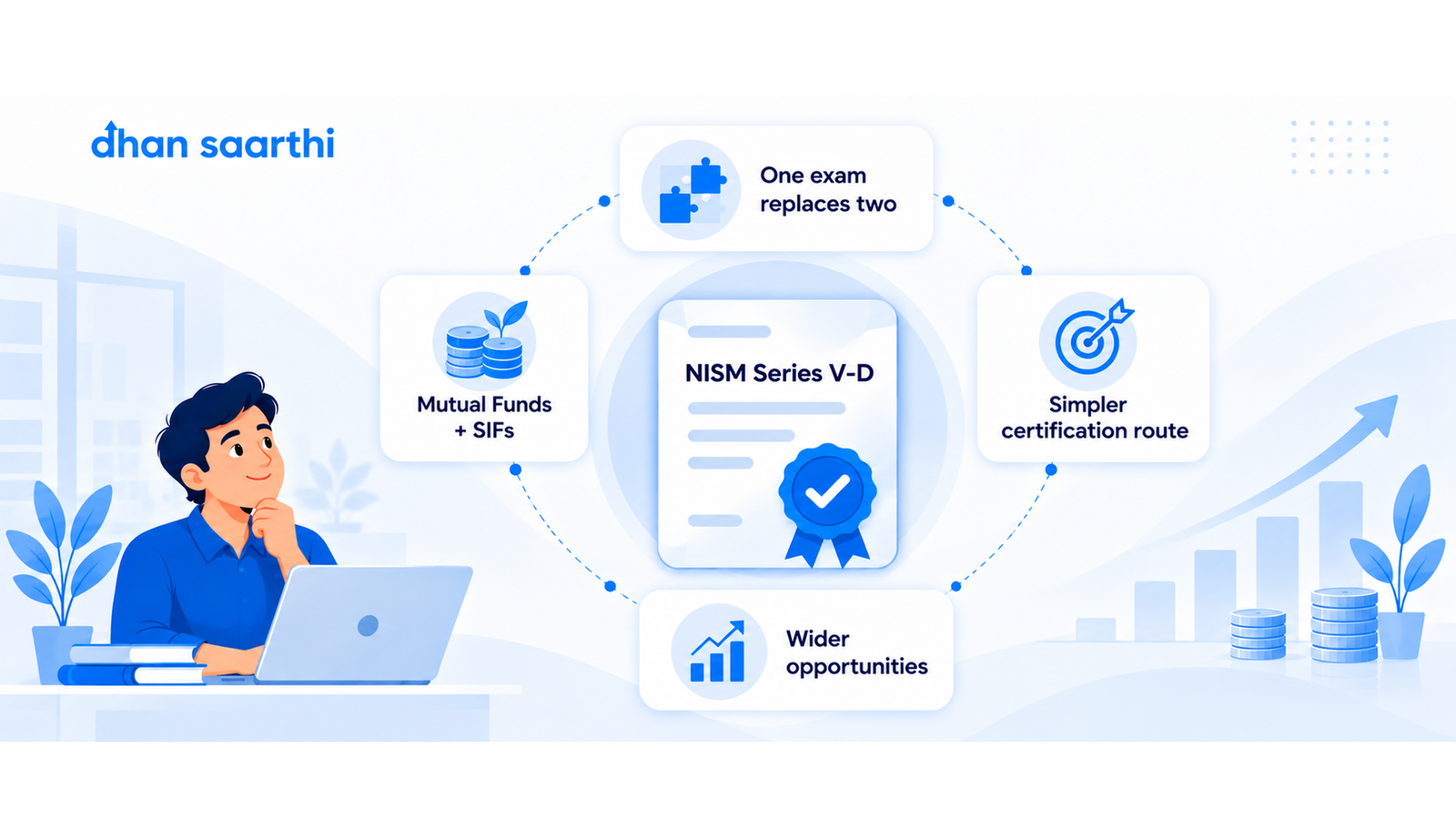
Quick Answer: NISM Series V-D is the Mutual Fund – Specialized Investment Fund Distributors Certification Examination, a single NISM certification for people who sell or distribute mutual funds and Specialized Investment Fund (SIF) products. NISM announced it through a communiqué dated July 14, 2026, and the exam was made available to candidates from July 22, 2026.
Why Did NISM Launch the NISM Series V-D Exam?
Until now, a distributor who wanted to sell both mutual funds and SIFs had to clear two separate exams: NISM Series V-A for mutual funds and NISM Series XIII (Common Derivatives) for SIFs. In its circular dated July 21, 2026, SEBI set out the new framework: anyone selling or distributing SIF products must hold a valid Series V-D certificate, and V-D holders can distribute both mutual fund and SIF products without separately holding V-A. The Series XIII requirement for SIF distribution does not apply after September 21, 2026. NISM specified the exam in consultation with SEBI through its July 14 communiqué.
Industry voices quoted by Business Standard described the change as one exam replacing two, with currency derivatives removed from the syllabus and more weight given to the mutual fund curriculum. AMFI's chief executive framed it as a simpler certification route that gives distributors a more complete view of the investment landscape. For a Mutual Fund Distributor, the practical takeaway is a shorter path to offering both product categories.
NISM Series V-D Syllabus: Modules, Chapters and Weightage
The exam has three modules and 22 chapters. Mutual fund content carries the largest share, while equity derivatives and interest rate derivatives together account for the rest. Chapter-wise marks below are taken from NISM Annexure I and topics from the official curriculum.
| Chapter | Marks | Topics Covered (per NISM curriculum) |
|---|---|---|
| Module 1: Mutual Fund Distributors • 45% of the paper (chapter marks total 68) | ||
| 1. Investment Landscape | 5 | Financial goals, asset classes, investment risks, behavioural biases, risk profiling, asset allocation |
| 2. Concept & Role of a Mutual Fund | 4 | Concept, classification of funds, industry growth in India |
| 3. Legal Structure of Mutual Funds in India | 3 | Fund structure, key constituents, AMC organisation, service providers, role of AMFI |
| 4. Legal and Regulatory Framework | 7 | Regulators, role of SEBI, AMC due diligence on distributors, grievance redressal, AMFI Code of Conduct |
| 5. Scheme Related Information | 7 | Mandatory documents and non-mandatory disclosures |
| 6. Fund Distribution and Channel Management Practices | 4 | Role and kinds of distributors, modes of distribution, revenue, SEBI commission disclosure, distributors vs investment advisers |
| 7. Net Asset Value, Total Expense Ratio and Pricing of Units | 5 | Fair valuation, NAV computation, loads, reporting requirements, segregated portfolio |
| 8. Taxation | 3 | Capital gains, dividend income, stamp duty, set-off, STT, Section 80C, TDS, GST |
| 9. Investor Services | 10 | NFO process, investment plans, allotment, account statements, KYC, cut-off time, systematic transactions, turnaround times |
| 10. Risk, Return and Performance of Funds | 5 | Risk factors, measures of return and risk, SEBI norms on representation of returns |
| 11. Mutual Fund Scheme Performance | 5 | Benchmarks, price vs total return index, tracking error, performance disclosure |
| 12. Mutual Fund Scheme Selection | 10 | Selection by investor needs and risk profile, risk levels, strategy-based selection, do's and don'ts |
| Module 2: Equity Derivatives • 35% of the paper (chapter marks total 52) | ||
| 13. Basics of Derivatives | 10 | Understanding derivatives, products in India, market participants, OTC vs exchange-traded, key risks |
| 14. Understanding Index | 5 | Index purpose, types and computation, construction and maintenance, equity indices in India |
| 15. Introduction to Forwards and Futures | 15 | Forwards and futures features, contract specifications, payoffs, cost-of-carry pricing, applications |
| 16. Introduction to Options | 13 | Option terminology, moneyness, intrinsic and time value, payoffs, pricing determinants and Greeks, implied volatility |
| 17. Strategies using Equity Futures and Options | 9 | Hedging, trading and arbitrage strategies, put-call parity, delta hedging, open interest and put-call ratio |
| Module 3: Interest Rate Derivatives • 20% of the paper (chapter marks total 30) | ||
| 18. Interest Rate, Interest Rate Instruments and Fixed Income Markets | 6 | Fixed income securities, term structure, yields, duration and convexity, debt markets in India |
| 19. Interest Rate Derivatives | 2 | Forwards, futures, options and swaps, market players, OTC vs exchange-traded |
| 20. Exchange Traded Interest Rate Futures | 10 | Contract specifications, payoffs, tick size, pricing, advantages and limitations |
| 21. Exchange Traded Interest Rate Options | 6 | Option contracts, moneyness, pricing factors and Greeks, implied volatility, payoff diagrams |
| 22. Strategies using Interest Rate Derivatives | 6 | Hedging, speculative and arbitrage trades, option strategies, spread trading |
Unlike Series XIII, the V-D syllabus does not include a currency derivatives module.
NISM Series V-D Exam Pattern, Fees and Passing Marks
Details below are from the NISM exam page and FAQs:
- ✓ Mode: Computer-based test with multiple-choice questions.
- ✓ Questions and marks: 150 questions of 1 mark each, 150 marks in total.
- ✓ Duration: 3 hours (180 minutes).
- ✓ Passing score: 60%, which is 90 marks out of 150.
- ✓ Negative marking: 10% of the marks assigned to a question.
- ✓ Exam fee: ₹3,000 plus applicable taxes; payment gateway charges are extra.
- ✓ Certificate validity: 3 years. The certificate is issued only if your PAN is furnished or updated in your registration details.
- ✓ Study material: Free workbook, downloadable from NISM after enrolment.
- ✓ Registration: Through the NISM certification portal, where you also choose your test centre, date and time slot.
Who Can Take the NISM Series V-D Exam?
NISM specifies V-D as the requisite standard for the following people:
- ✓ Distributors, agents, brokers or authorised persons, called by any name, who are employed or engaged (or about to be) in selling or distributing mutual fund and SIF products.
- ✓ Individual mutual fund and SIF distributors, including those planning to add SIFs to an existing mutual fund practice.
- ✓ Employees of organisations engaged in sales and distribution of mutual fund and SIF products.
- ✓ AMC employees, especially those in sales and distribution of these products.
- ✓ Existing SIF distributors: those holding a valid Series XIII certificate obtained on or before September 21, 2026 need not take V-D until that certificate expires, and must keep a valid V-A meanwhile.
- ✓ Mutual-fund-only distributors: SEBI allows them to continue with Series V-A.
What Happens After Passing the NISM Series V-D Exam?
You receive a NISM certificate valid for 3 years, issued once your PAN details are on record. To renew, you need to pass the V-D exam again before the certificate expires. Under SEBI's framework, a V-D certificate makes you eligible to distribute both mutual funds and SIFs, without a separate V-A.
To start your business, the next step is an ARN from AMFI. The AMFI registration process is online and Aadhaar-authenticated, and includes the Know Your Distributor (KYD) process. Fees reported by Cafemutual for an individual ARN are ₹3,000 for registration and ₹1,500 for renewal, excluding GST, effective October 1, 2024. After the ARN, you empanel with the AMCs whose schemes you plan to distribute.
How Dhan Saarthi Helps You Clear NISM Series V-D and Start Your Business
Preparing for a 150-question exam while building a practice is hard to manage alone. Dhan Saarthi supports aspiring distributors through the exam journey with structured exam notes, practice mock test links, guidance on registering for the exam and help with preparation so you can clear it with confidence.
Once you pass, we help you get your ARN, complete Dhan Saarthi onboarding and start building your mutual fund and SIF business with the tools and workflows you need from day one.
Ready to Start Your Mutual Fund and SIF Practice?
See how Dhan Saarthi supports you from exam preparation to your first client.
Book a Demo with Dhan SaarthiConclusion
NISM Series V-D brings mutual fund and SIF distribution under one certification. It asks for more than V-A, with a 60% pass mark, negative marking and two derivatives modules, so plan your preparation around the module weightage and keep the study schedule steady.
For Mutual Fund Distributors, the exam is the first step in a longer path: certificate, ARN, AMC empanelment and then the client work that builds a practice. Confirm the latest exam and fee details on the NISM and AMFI websites before you register.