A client can hold six mutual fund schemes across four fund houses and still be sitting in the same twenty stocks. Fund overlap doesn't show up in a scheme name or a fact sheet headline — it hides in the underlying holdings, and most clients never think to check. For a Mutual Fund Distributor, this is a quiet risk that can undo years of careful portfolio construction. This guide breaks down why overlap happens, the signals that reveal it, and a practical way to catch it before it becomes a client conversation you didn't see coming.
What Is Fund Overlap in a Mutual Fund Portfolio?
Fund overlap happens when two or more mutual fund schemes in the same client portfolio hold a significant number of the same underlying stocks or sectors. The schemes may have different names, different fund houses, and even different category labels — but underneath, the client is repeating the same exposure instead of spreading it.
This matters because diversification is the entire premise most clients were sold on when they added a second, third, or fourth fund. If three of those funds are quietly holding the same large-cap names, the client isn't diversified — they're concentrated, just across multiple statements instead of one.
Overlap on its own isn't always a problem. Some degree of common holding across large-cap or flexi-cap schemes is normal and expected. The issue is when overlap becomes high enough that a market fall in a handful of stocks moves the client's entire portfolio in the same direction, at the same time — and the client believes they were protected because they held "different funds."
Why Does Fund Overlap Happen in Client Portfolios?
Overlap rarely happens by design. It builds up quietly, one addition at a time, usually for reasons that made sense in isolation:
A client adds a new SIP after reading about a top-rated scheme, without checking what it already holds elsewhere. A Mutual Fund Distributor recommends a fund from a different fund house purely for diversification of the fund house relationship, not the underlying portfolio. A client who inherited investments or consolidated accounts from a previous advisor ends up with schemes that were never reviewed together. Category definitions also shift over time — two funds that started in different categories can end up with very similar portfolios after a mandate change or a scheme merger.
Why this matters to your practice: A portfolio that looks well-diversified on paper — five or six fund names, multiple fund houses — can still carry hidden concentration risk. If a client discovers this on their own, usually after a sharp fall across "different" funds, the conversation becomes about your oversight, not the market.
The good news is that overlap is one of the more detectable risks in portfolio management, provided you know what signals to look for and check for them regularly rather than only when a client raises a question.
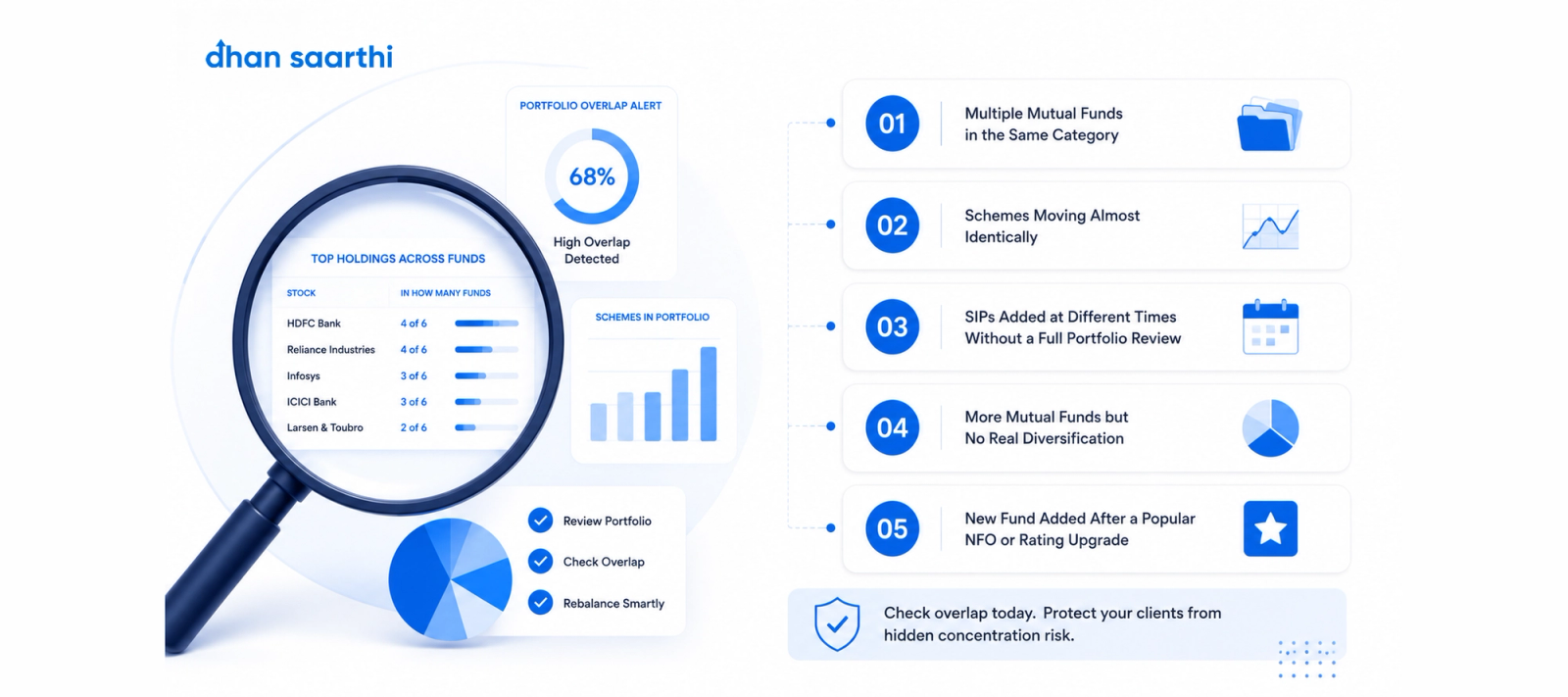
5 Signs of Fund Overlap in a Client Portfolio
Signal 01
Multiple Mutual Funds in the Same Category
Two or three large-cap funds, two flexi-cap schemes, or multiple index-tracking funds sitting side by side is the most straightforward overlap signal — and often the easiest one to miss because each fund was added for a seemingly valid reason at the time.
Funds in the same broad category are structurally more likely to hold the same large, liquid stocks, simply because there are only so many companies that qualify at the top of the market.
How to Check
Group every scheme in the client's portfolio by category before you look at anything else. Any category with more than one scheme deserves a closer look at the underlying holdings, not just the category label.
Signal 02
Mutual Fund Schemes Moving Almost Identically During Market Swings
If a client's schemes consistently rise and fall together, on the same days, by roughly the same magnitude, that's a behavioural clue that they're holding largely the same underlying exposure — even if the fund names and fund houses are different.
This is often the moment a client notices something is off, even before they understand why. "Why did all my funds fall together?" is a question worth taking seriously.
How to Check
During a portfolio review, compare the movement pattern of each scheme over the same period. Schemes that move almost in lockstep are a prompt to check underlying holdings, not just past performance.
Signal 03
SIPs Added at Different Times Without a Full Portfolio Review
Portfolios built up over several years, especially ones that combine a Mutual Fund Distributor's suggestions with a client's own additions, are the most prone to overlap. Each fund made sense when it was added. Nobody looked at the full portfolio together.
This is especially common with clients who have been investing for eight to ten years and have simply added a new scheme every couple of years without ever removing an older one.
How to Check
Pull up the client's complete scheme list with the date each SIP or lump sum was added. If the list has grown steadily without a single scheme being removed or consolidated, treat that portfolio as a priority for an overlap review.
Signal 04
More Mutual Funds but No Real Diversification
More schemes should, in theory, reduce concentration. In practice, adding funds without checking underlying holdings often does the opposite — the client ends up paying for more paperwork and more folios without meaningfully spreading their risk.
A portfolio with eight schemes but heavy repetition across the top ten holdings is functionally less diversified than a portfolio with three well-chosen schemes across genuinely different mandates.
How to Check
Look at the client's top holdings across all schemes combined, not scheme by scheme. If the same handful of companies keep appearing near the top across multiple schemes, the fund count is misleading the client about how diversified they actually are.
Signal 05
A New Fund Added After a Popular NFO or Rating Upgrade
Clients often want to add a fund that's getting attention — a new fund offer, a scheme that's just been upgraded in a rating list, or one a colleague has mentioned. The decision is usually driven by recent performance or buzz, not by whether it fills a genuine gap in the portfolio.
These additions are a common source of overlap because trending schemes at any given time tend to hold similar high-conviction stocks across fund houses.
How to Check
Before adding any new scheme to an existing portfolio, check its top holdings against what the client already owns. Treat this as a standard step in the recommendation process, not an optional extra.
How to Check Mutual Fund Overlap in a Client Portfolio
Detecting overlap for one client is manageable. Doing it consistently across an entire client book, every time a scheme is added or reviewed, is where most manual processes fall behind. Below is a simple framework to work through during a portfolio review.
| Warning Sign | What to Check | When to Act | Risk Level |
|---|---|---|---|
| Multiple schemes in the same category | Category grouping across the full portfolio | At every portfolio review | Medium |
| Schemes moving in lockstep | Movement pattern comparison over recent months | When client questions performance | High |
| Portfolio built up over many years without review | Scheme list with addition dates | Annual portfolio consolidation review | High |
| Fund count rising without added diversification | Combined top holdings across all schemes | Before recommending any new scheme | Medium |
| New scheme added on recent buzz or a rating upgrade | Holdings check against existing schemes before adding | Before the transaction is placed | Medium |
💡 There is no single overlap percentage that applies to every client or every category combination — thresholds vary by portfolio tool, category, and risk framework. Treat any overlap figure as a starting point for a closer review, and verify it against your own portfolio analysis process before discussing it with a client.
3 Habits That Prevent Mutual Fund Overlap From Building Up
- ✓ Check the underlying holdings of any new scheme against the client's existing portfolio before recommending it — not after.
- ✓ Review each client's full scheme list at least once a year specifically for category concentration, not just performance.
- ✓ When consolidating a portfolio, prioritise removing genuinely overlapping schemes over simply adding another one to "balance it out."
How Dhan Saarthi Helps You Detect Fund Overlap Before It Causes a Problem
Checking overlap manually for one client is straightforward. Doing it consistently across a full client book — every time a scheme is added, every time markets move, every time a review comes up — is where most Mutual Fund Distributors and advisors run out of time.
Dhan Saarthi is built to make this visible without the manual effort. Here's what that looks like in practice:
- ✓ Combined portfolio view. See every client's schemes and category exposure together in one place, instead of piecing it together statement by statement.
- ✓ Portfolio health flags. Surface portfolios that haven't been reviewed in a while, so category concentration doesn't sit unnoticed for years.
- ✓ Curated model portfolios. Recommend from ready-built baskets designed around genuine diversification, instead of adding a scheme on its own and checking for overlap afterward.
- ✓ Client-level review history. Know exactly when each client's portfolio was last reviewed, so overlap checks become a routine step rather than an afterthought.
The goal is to help you catch overlap during a routine review — not after a client has already noticed their "diversified" portfolio moving as one.
See Fund Overlap Detection in Action
Book a demo to see how Dhan Saarthi flags category concentration and overlap across your entire client book — without checking each portfolio by hand.
Request a Dhan Saarthi DemoBuild Portfolios Designed to Avoid Overlap From the Start
Explore curated model portfolio baskets on Dhan Saarthi, built for genuine diversification rather than another fund added on top of what a client already owns.
Explore Model Portfolios on Dhan SaarthiConclusion
Fund overlap is easy to miss because it hides behind the appearance of diversification — different names, different fund houses, different scheme labels. But underneath, a portfolio can be far more concentrated than it looks, and that concentration only becomes visible to a client when markets move against it.
The Mutual Fund Distributors and advisors who protect client trust best are the ones who check for overlap before it becomes a problem — at the point of every new recommendation, and at every scheduled portfolio review. It's a small habit with an outsized effect on how well a client's portfolio actually behaves when it's tested.