Most Mutual Fund Distributors don't lose time on client conversations — they lose it pulling data, formatting sheets, and re-sending the same report in five different ways for five different clients. A reporting system fixes this permanently. This guide walks through how to build one that runs on a schedule instead of running on you.
Why Client Reporting Gets Harder to Manage as Your MFD Book Grows
At 20–30 clients, manual reporting is inconvenient but survivable. You pull a portfolio statement, format it, add a note, and send it. At 100 or 200 clients, that same process consumes an entire week every quarter — and it's the first thing that gets skipped when things get busy.
The problem isn't effort. It's that most reporting workflows are built to be repeated manually, client by client, rather than built as a system that scales without extra hours. The moment your client book grows faster than your reporting process, reports get delayed, inconsistent, or skipped entirely for the clients who don't ask for them — usually the ones who need them most.
Why this matters to your practice: Clients rarely leave because a report was late. They leave because inconsistent reporting quietly signals inconsistent attention. A reliable reporting cadence is one of the simplest ways to protect trust across a growing client book.
The fix isn't working faster. It's building a system where reporting happens on a schedule, in a consistent format, with manual effort reserved only for the clients who genuinely need a conversation. Below is a practical framework for setting that up.
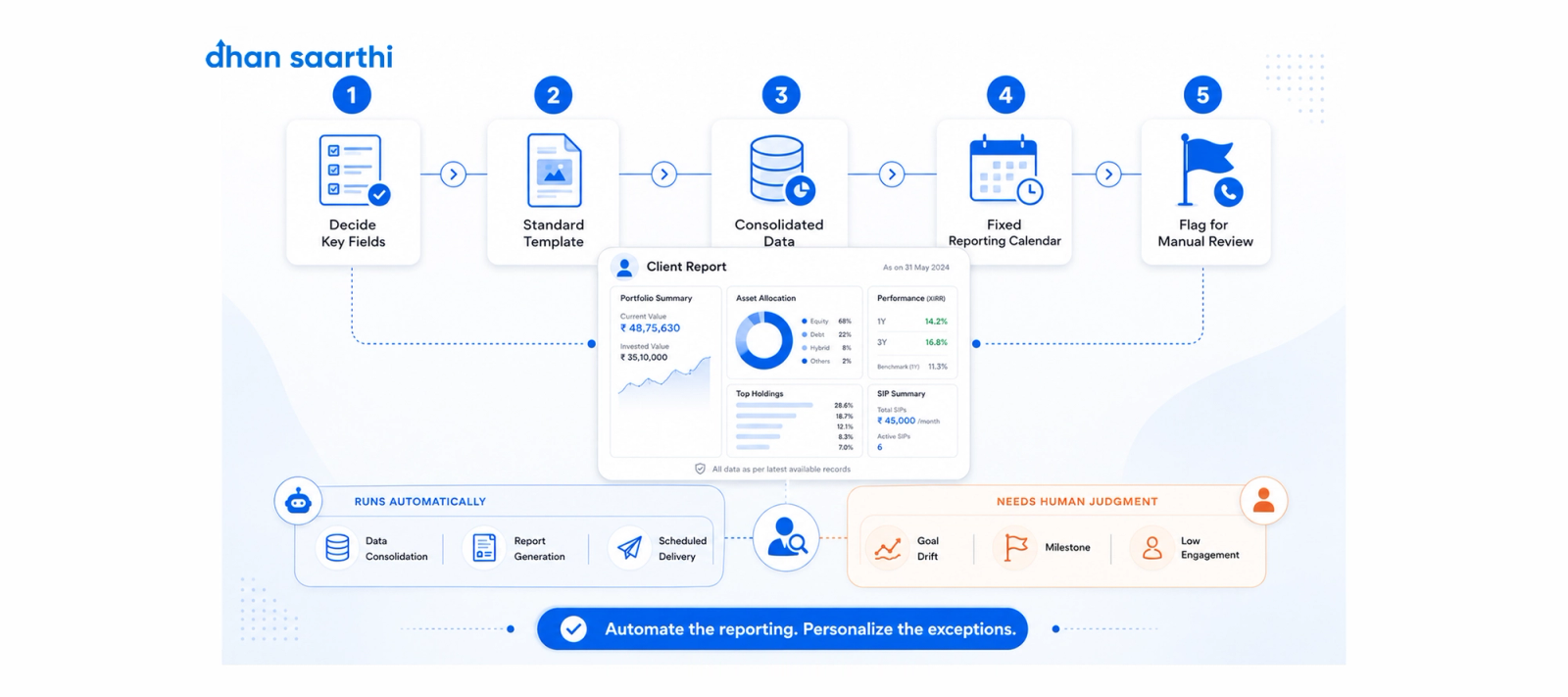
How to Build a Client Reporting System That Runs Without You: 5 Steps
Step 01
Decide What Information Clients Need to See Before Choosing a Reporting Tool
Most reporting systems fail before they start because the format is decided by whatever a spreadsheet or software happens to export, not by what the client actually wants to know. Before automating anything, fix the content: current value, investment amount, gain or loss, and progress against the client's stated goal.
A report with ten data points that gets ignored is worse than a report with four data points the client actually reads every time.
Action
Write down the five fields every client report must contain before picking a format or a tool. Keep it identical across your entire book — consistency is what makes automation possible in the next step.
Step 02
Create One Standard Client Report Template for Your Entire Book
Custom formatting per client feels personal, but it's the single biggest reason reporting stays manual. A different layout for every family, every HNI client, or every SIP portfolio means every report has to be built from scratch.
One clean, well-designed template — used for every client, with only the numbers changing — is what allows reporting to move from a manual task to an automated one.
Action
Build one report layout that works for a salaried client, a family portfolio, and an HNI client alike. Personalise the note at the top, not the structure underneath.
Step 03
Stop Pulling Client Portfolio Data One Account at a Time
The most time-consuming part of reporting is rarely the writing — it's the data pull. Logging into multiple platforms, exporting statements, and manually consolidating numbers for each client is where hours disappear every month.
This step is the biggest lever in the entire system. If data still has to be pulled manually per client, no template or schedule will make reporting genuinely low-effort.
Action
Move to a single consolidated view of your entire client book rather than pulling data one account at a time. This is the step that turns reporting from a per-client chore into a batch process.
Step 04
Set a Fixed Client Reporting Calendar Instead of Reporting on Request
Ad-hoc reporting — sending a report only when a client asks — creates two problems. Clients who don't ask often go unreported for months, and clients who do ask create unplanned work that interrupts everything else on your calendar.
A fixed cadence removes both problems. Everyone gets a report on the same schedule, whether they asked or not.
Action
Pick a cadence — monthly for HNI clients, quarterly for the rest is a common starting point — and set fixed dates for the year. Treat the date as non-negotiable, the same way you would a client meeting.
Step 05
Reserve Manual Reporting Effort for the Clients Who Actually Need It
Not every client needs the same level of manual attention on every report. Most reports simply need to go out on schedule. The exceptions — a client whose portfolio has drifted from their goal, a client approaching a milestone, a client who hasn't engaged in months — are the ones that deserve a personal note or a call.
Building the system this way means your time goes to the clients who need it, not to formatting the same statement two hundred times.
Action
Define two or three simple flags — goal drift, no recent engagement, upcoming milestone — that mark a client for a manual touchpoint alongside their scheduled report. Everyone else gets the standard report, untouched by hand.
Client Reporting Workflow: What to Automate and What Needs Manual Review
Once the five steps above are in place, it helps to be explicit about which parts of the workflow should run on their own and which parts still need your judgment.
| Workflow Stage | Should Run On Schedule | Needs Manual Attention | Frequency |
|---|---|---|---|
| Data consolidation across client portfolios | Yes | Only if data looks inconsistent | Every reporting cycle |
| Standard report generation and delivery | Yes | No, unless client flagged | Monthly / quarterly |
| Goal-drift or milestone review | Partial | Yes — needs a conversation | As flagged |
| Disengaged-client outreach | No | Yes — always personal | As flagged |
💡 A reporting system doesn't remove the personal relationship — it protects it. Automating the repetitive parts is what frees up time for the conversations that actually build trust.
Three Habits That Keep a Client Reporting System Running With Minimal Manual Work
- ✓ Lock the reporting template once — resist the urge to redesign it for individual clients. Consistency is what makes the system scalable.
- ✓ Set fixed reporting dates on a calendar at the start of the year, and treat them as fixed commitments, not flexible tasks.
- ✓ Review flagged clients before every reporting cycle so manual attention goes only where it's genuinely needed.
How Dhan Saarthi Helps You Run Client Reporting With Less Manual Work
Dhan Saarthi lets you generate consolidated client reports directly from your book, instead of pulling data from separate platforms and formatting each statement by hand. Portfolio value, invested amount, gains, and goal progress come together in one standard report format, which is what makes a fixed reporting cadence realistic across 100 or more clients instead of just a handful.
Because reports are generated from a single, up-to-date source, you can run your entire reporting cycle on schedule without re-checking numbers client by client — leaving your time for the clients who need a personal update rather than a standard one.
See How Dhan Saarthi Simplifies Client Reporting
Book a demo to see how consolidated, consistent client reports can run on schedule instead of on manual effort.
Book a Demo With Dhan SaarthiConclusion
A client reporting system that runs with minimal manual work isn't built by working faster — it's built by deciding what clients need to see, standardising the format, consolidating the data, fixing a schedule, and reserving personal attention for the clients who genuinely need it.
Once that system is in place, reporting stops being a monthly scramble and becomes one of the quietest, most reliable ways you demonstrate consistent attention to every client in your book — regardless of how large that book grows.