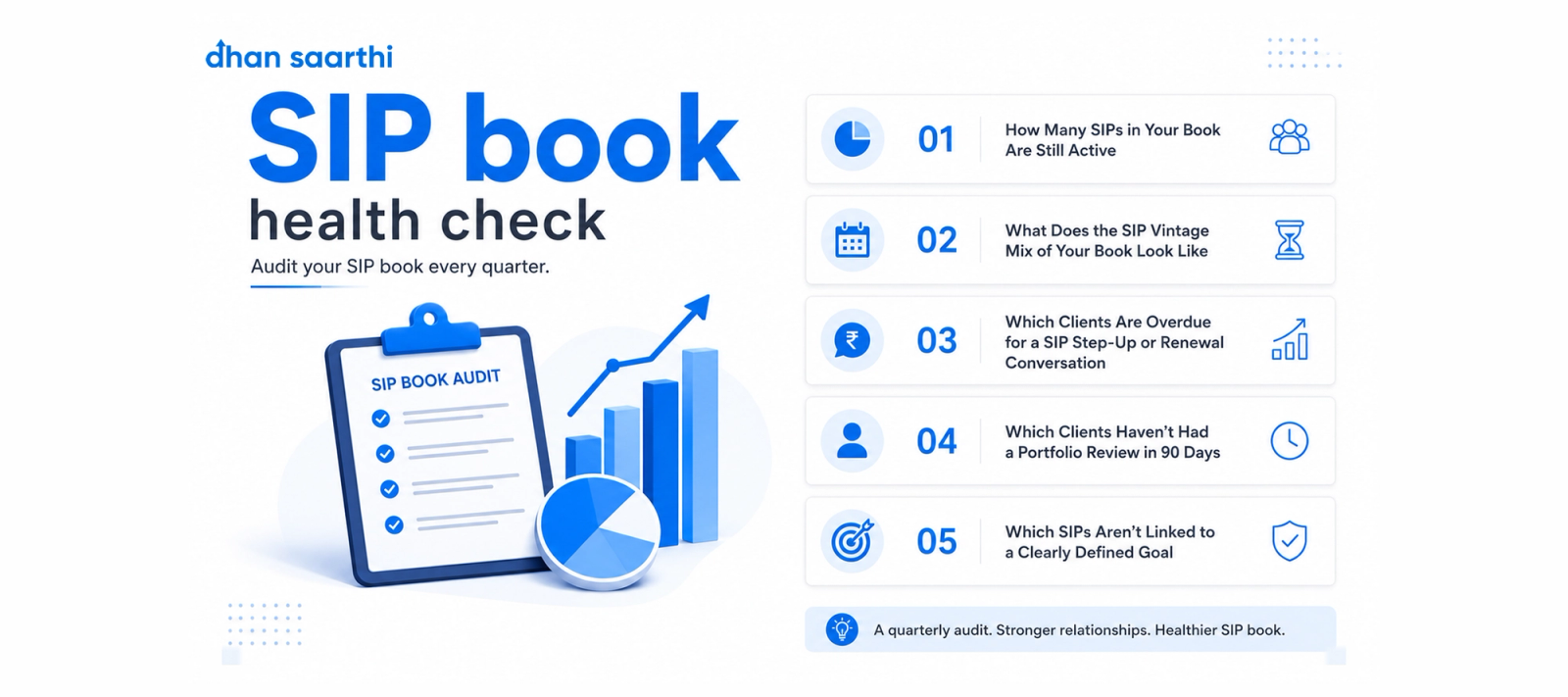
Most Mutual Fund Distributors review individual client portfolios often, but rarely step back and audit the SIP book as a whole. A quarterly SIP book health check closes that gap. It's a structured, five-point review that surfaces lapsed SIPs, at-risk clients, and review gaps before they turn into cancellations or lost trust.
Why a Quarterly SIP Book Health Check Matters for Every Mutual Fund Distributor
A SIP book can look stable on the surface while quietly weakening underneath. Individual client conversations tell you how one relationship is doing. They don't tell you how the entire book is trending — how many SIPs have lapsed, how many clients haven't been reviewed in months, or how much of your book is concentrated in the vintage that cancels most often.
This is where a periodic audit earns its place. Instead of reacting to individual cancellation requests as they arrive, a quarterly health check gives you a book-level view — so you can prioritise outreach based on actual risk, not on who happens to call you first.
Why this matters to your practice: A handful of cancellations spread across a few months rarely feels urgent in the moment. Reviewed together at a book level, the same numbers often reveal a pattern — a review gap, a communication lapse, or a vintage segment that needs attention before it compounds further.
Below is a five-point framework you can run every quarter, regardless of the size of your book.
SIP Book Audit Checklist: 5 Points to Review Every Quarter
Audit Point 01
How Many SIPs in Your Book Are Still Active
Start with the basics: how many SIPs are active, how many are paused, and how many have stopped without a formal cancellation. This last category is easy to miss — a SIP that quietly fails a debit two or three times in a row often sits unnoticed until a client statement finally gets reviewed.
A book with a rising share of paused or failed SIPs is telling you something, even if no client has said a word.
Action
Pull a simple active-versus-paused-versus-lapsed count for the full book each quarter. Flag every lapsed SIP for a direct conversation within the same week — not a general reminder, but a specific check on what changed for that client.
Audit Point 02
What Does the SIP Vintage Mix of Your Book Look Like
Not every SIP carries the same cancellation risk. Newer SIPs — typically the ones running for less than 18 months — tend to be more sensitive to short-term market moves and second-guessing, simply because the client hasn't yet seen the SIP work through a full cycle.
If a large share of your book sits in this newer vintage, that segment needs more frequent, more deliberate communication — not the same cadence you'd use for a client whose SIP has run for five years.
Action
Segment your book by SIP vintage each quarter. Build a shorter, more proactive touchpoint cadence specifically for clients under 18 months, since this segment is where early disengagement is hardest to spot and most costly to lose.
Audit Point 03
Which Clients Are Overdue for a SIP Step-Up or Renewal Conversation
A SIP amount decided two or three years ago rarely reflects a client's current income or goal timeline. Clients who've had a salary increment, a bonus year, or a shift in priorities are often open to a step-up conversation — but only if someone raises it.
Left unaddressed, this isn't just a missed growth opportunity for your book. It also means a client's SIP amount may no longer be aligned with the goal it was meant to serve.
Action
List every SIP that hasn't seen a step-up conversation in the last 12 months. Prioritise clients whose goal timeline suggests the current amount may be falling short, and raise it as a planning conversation — not a sales pitch.
Audit Point 04
Which Clients Haven't Had a Portfolio Review in 90 Days
A review gap is one of the clearest early warning signs in a SIP book. Clients who haven't heard from you in three months or more are the ones most likely to be influenced by outside noise — a direct plan comparison, a friend's advice, or simple disengagement from the relationship.
This is often the hardest gap to see, because these are, by definition, the clients who aren't reaching out to you.
Action
Maintain a simple last-reviewed date against every client record. Each quarter, pull the list of clients crossing the 90-day mark and schedule their check-in before the gap widens further.
Audit Point 05
Which SIPs Aren't Linked to a Clearly Defined Goal
A SIP that exists purely as "a mutual fund investment" is far easier to cancel than one a client can name a purpose for — a child's education, a home down payment, retirement. When a SIP isn't anchored to a specific goal, short-term market noise has much more room to shake a client's conviction.
Auditing your book for goal-linkage isn't just a record-keeping exercise. It tells you exactly which conversations to have, and with whom.
Action
Check every SIP in your book against a named goal. For SIPs with no goal on record, use the next client conversation to establish one — it gives both of you a shared reference point for every future review.
Quarterly SIP Book Audit Checklist at a Glance
Here's how the five audit points map to what you're checking, and roughly how urgent each one tends to be once flagged.
| Audit Point | What You're Checking | Suggested Frequency | Risk if Ignored |
|---|---|---|---|
| Active vs. paused vs. lapsed SIPs | SIP status across the full book | Quarterly | High |
| SIP vintage mix | Share of book under 18 months | Quarterly | Medium |
| Step-up / renewal readiness | Clients due for a SIP amount review | Half-yearly | Medium |
| Client review recency | Clients crossing the 90-day no-touchpoint mark | Quarterly | High |
| Goal-linkage of each SIP | SIPs with no named goal on record | Half-yearly | Medium |
💡 The audit itself takes far less time than the conversations it generates. Treat the audit as the input — the real value comes from acting on what it surfaces, one client conversation at a time.
How to Make Your Quarterly SIP Book Audit a Consistent Habit
- ✓ Put the audit on a fixed calendar date each quarter — treat it like a recurring business task, not something you'll get to when time allows.
- ✓ Convert every flag from the audit into a named action against a named client — an audit that doesn't lead to a conversation isn't adding value.
- ✓ Review your own audit results over time. A book that's improving quarter over quarter tells you your process is working — one that isn't tells you where to focus next.
How Dhan Saarthi Simplifies Your Quarterly SIP Book Audit
Running this audit manually across a book of even 50 clients means pulling data from multiple statements and spreadsheets — which is exactly why most Mutual Fund Distributors end up doing it once a year, if at all. Dhan Saarthi's client management view is built to bring SIP status, vintage, and review history together in one place, so the five-point audit above becomes a quarterly routine instead of an occasional exercise.
Instead of checking each client account separately, you can see your full SIP book at a glance — which SIPs are active, which have lapsed, and which clients are due for a review — and move straight into the conversations that matter, rather than spending the quarter just gathering the data.
Run Your Quarterly SIP Book Audit in One Place
See SIP status, vintage, and review history across your entire client book — and know exactly who to reach out to first.
Book a Free Demo with Dhan SaarthiConclusion
A quarterly SIP book health check isn't about adding more work to an already full calendar. It's about replacing scattered, reactive check-ins with a single structured review that tells you exactly where your book needs attention — before a client picks up the phone to cancel.
The five audit points above don't require any new tools to start. What they require is consistency — the same review, done every quarter, treated as seriously as any other part of your practice.