A finance degree is not the entry ticket most people assume it is. Becoming a Mutual Fund Distributor in India is a certification-and-registration path, not an academic one. This guide walks through what is actually required, the step-by-step process, and what tends to trip up people who come from a non-finance background.
Do we Need a Finance Degree to Become a Mutual Fund Distributor
No. There is no requirement, anywhere in the certification or registration process, that asks for a degree in finance, commerce, or economics. This is one of the most persistent myths that keeps capable people from even exploring the path.
What the process actually asks for is a certification exam and a registration number — not a transcript. Insurance agents, teachers, retired bank staff, working professionals from unrelated industries, and homemakers with strong local networks have all built distribution practices without a finance background.
Why this matters: Treating "no finance degree" as a disqualifier stops people at the research stage. The real filters are the certification exam, the registration process, and — more than either of these — the ability to earn and hold client trust.
That said, the process does have real requirements. Below is what they are, followed by the exact sequence to complete them.
What Qualifications Are Actually Required to Become a Mutual Fund Distributor
The core requirements sit in two places: a certification exam conducted by the National Institute of Securities Markets (NISM), and a registration process managed by the Association of Mutual Funds in India (AMFI), which issues the ARN — the Mutual Fund Distributor's registration number.
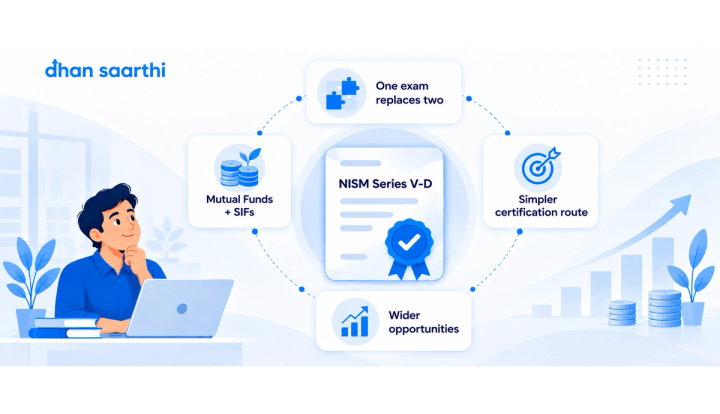
Certification: Candidates are required to clear the NISM Mutual Fund Distributors certification examination. This tests product knowledge, regulatory basics, and distribution practices — not a finance degree.
Registration: After clearing the exam, candidates apply for an ARN through AMFI, which involves submitting identity, address, and exam-related documentation.
Ongoing compliance: ARN holders are expected to keep their certification and registration current through renewal requirements set by the regulator.
Note
Exact eligibility criteria (minimum age, educational qualification if any, exam pattern, passing score, certificate validity, and renewal cycle) should be confirmed against the current NISM and AMFI websites before this article goes live, since these details are periodically revised by the regulator.
Why a Finance Background Is Not Mandatory for Mutual Fund Distribution
Mutual Fund distribution is, at its core, a relationship and communication business. The certification exam builds the required product and regulatory knowledge. What it cannot teach — and what actually determines whether a distribution practice grows — are skills that have nothing to do with a finance degree.
- ✓ Trust-building. Clients invest with people they trust, not with the person who scored highest on a finance exam.
- ✓ Local network and reach. Many successful distributors start with the network they already have — colleagues, community, family circles — before expanding.
- ✓ Consistent communication. Clients stay invested when they hear from their distributor regularly, not when their distributor has a finance degree.
- ✓ Willingness to keep learning. Product knowledge can be built after entry, through the certification, AMC training, and continuous reading — it does not need to exist on day one.
This does not mean product knowledge is optional. It means the starting qualification is a certification, not a degree — and the long-term differentiator is how well a distributor serves clients, not their academic background.
Step-by-Step Process to Become a Mutual Fund Distributor
Step 01
Clear the NISM Mutual Fund Distributors Certification
This is the starting point for anyone, regardless of educational background. The exam covers mutual fund basics, product categories, regulatory framework, and distribution practices. Study material is publicly available through NISM, and candidates with no prior finance exposure regularly clear it with structured preparation.
Step 02
Apply for Your ARN Through AMFI
Once certified, the next step is applying for the ARN — the unique registration number that identifies you as a registered Mutual Fund Distributor. This involves submitting the required application, identity and address proof, and certification details through the process AMFI prescribes.
Step 03
Empanel With Asset Management Companies or a Distribution Platform
With an active ARN, the next step is empanelment — registering with individual Asset Management Companies, or joining a platform that gives access to multiple fund houses, transaction tools, and client servicing infrastructure in one place. For someone starting without a finance background, a platform-led approach usually reduces the operational learning curve significantly.
Step 04
Start Building Your Client Base
Most distributors begin with people they already know — family, colleagues, and community contacts — before expanding through referrals. This stage is where relationship skills matter far more than academic background. Early clients are won on trust and consistent communication, not on credentials.
What Challenges Do we face as a Mutual Fund Distributor With No Finance Background
The certification and ARN clear the entry barrier. What comes after is where non-finance-background distributors often need a deliberate plan.
| Challenge | Why It Happens | Practical Fix |
|---|---|---|
| Limited product knowledge in the early months | Certification covers basics, not depth across every category | Use AMC training resources and structured platform content consistently, not just before the exam |
| Establishing credibility with first clients | No prior track record or finance-industry association | Start with warm relationships, be transparent about being new, and let consistent service build the reputation |
| Operational overload — paperwork, transactions, servicing | No prior exposure to back-office or compliance workflows | Use a distribution platform that handles transactions, reporting, and compliance-aware workflows so the focus stays on clients |
| Explaining direct plans and advisor value to clients | Clients increasingly research online before speaking to a distributor | Anchor every conversation to the service and guidance a client receives, not just the fund selection |
None of these challenges are unique to people without a finance background — every new distributor faces some version of them. The difference is that a non-finance starting point makes a structured system, rather than instinct, more important from day one.
How Dhan Saarthi Helps New Mutual Fund Distributors Without a Finance Background
The gap for a new, non-finance-background distributor is rarely knowledge alone — it is having the operational and client-servicing infrastructure that an experienced distributor builds up over years, available from day one.
Dhan Saarthi is built to close exactly that gap. Here's what that looks like in practice:
- ✓ Guided onboarding for new ARN holders. Get your practice structured from the start, without having to figure out workflows by trial and error.
- ✓ Portfolio health analysis for clients. Present clients with structured, easy-to-explain portfolio insights, even without years of product depth.
- ✓ Goal-based investing tools. Frame every client conversation around a named goal instead of fund-by-fund comparisons — a far easier conversation for a new distributor to lead.
- ✓ One dashboard for client and SIP book management. Spend your early months on relationships and outreach, not on scattered paperwork and manual tracking.
The goal is not to replace what you bring as a distributor — it's to give you the structure that experienced distributors already have, so your lack of a finance degree never has to show up as a lack of professionalism.
Starting Your Mutual Fund Distribution Practice
See how Dhan Saarthi helps new and non-finance-background Mutual Fund Distributors get client-ready faster.
Request a Dhan Saarthi DemoConclusion
A finance degree was never the real barrier to becoming a Mutual Fund Distributor — a lack of clarity about the actual process was. The path runs through a certification exam, an ARN registration, empanelment, and then the slow, relationship-driven work of building a client base.
People from every kind of professional background have built credible distribution practices this way. What separates the ones who succeed is not their degree — it's whether they treat the certification as a starting point, build a system for client servicing early, and stay consistent with communication once clients are on board.