A slow onboarding process is one of the quietest ways a Mutual Fund Distributor loses a client before the relationship even starts. Most delays don't come from the paperwork itself — they come from doing the same five steps in the wrong order, every single time. This guide breaks the process into a repeatable 30-minute sequence you can run for every new client.
Why Does Onboarding Speed Matter for a Mutual Fund Distributor?
A new client rarely decides to invest and then waits patiently for weeks while paperwork gets sorted out. Between the moment they say "yes" and the moment their first investment is confirmed, their attention — and sometimes their conviction — is still fragile.
Every extra day spent chasing documents, re-explaining the same form, or waiting for a callback is a day the client has to reconsider, compare, or simply lose momentum. A slow start also sets the tone for the entire relationship — it signals disorganisation before the client has even seen a single portfolio update.
Why this matters to your practice: Onboarding is the first real proof point a client has of how you operate. A clean, quick, confident process builds trust before a single rupee is invested. A messy one puts that trust in question from day one.
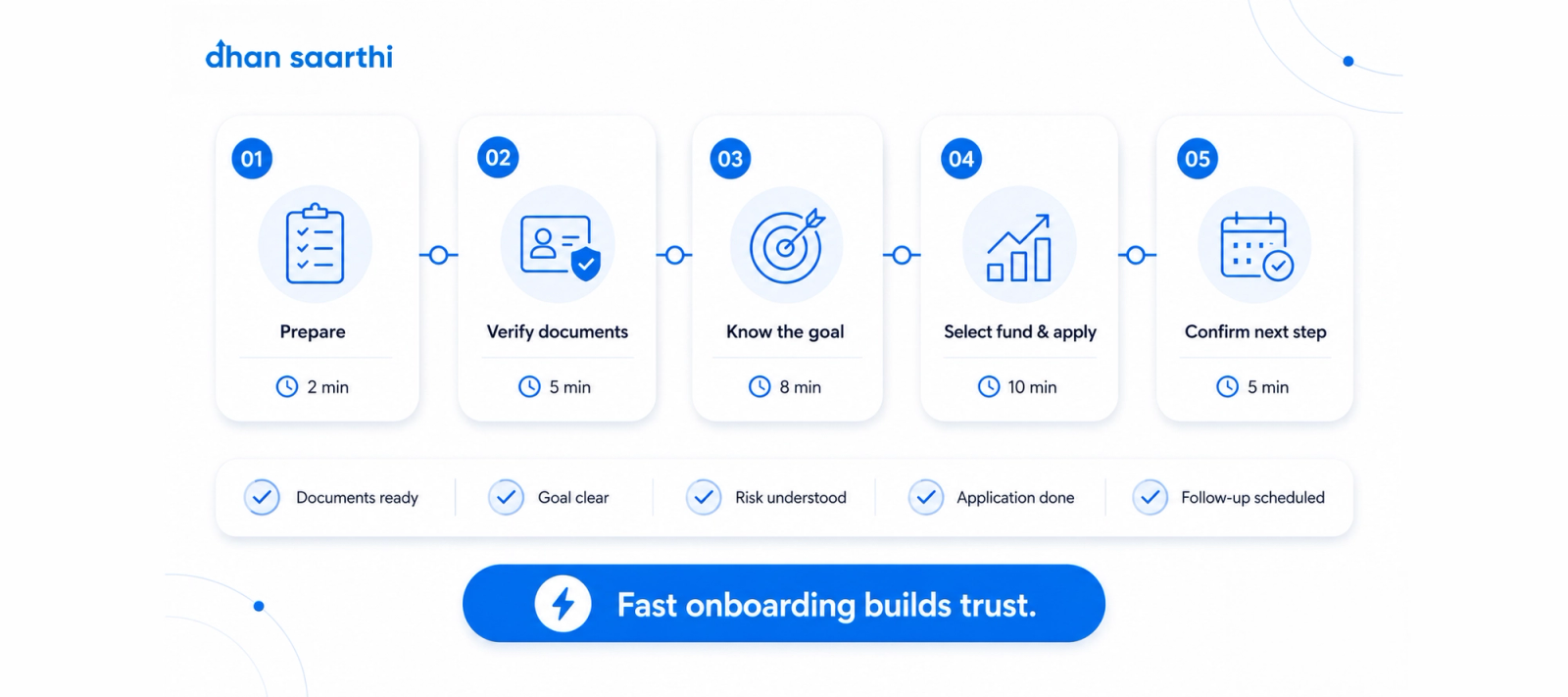
The good news: onboarding doesn't need to be slow. It needs to be sequenced correctly. Below is a five-step process designed to fit inside a single 30-minute sitting — in person, on a call, or over video.
How to Onboard a New Client in 30 Minutes: A Step-by-Step Process
Step 01 · 2 minutes
How to Prepare Before the Client Sits Down
Most onboarding delays happen not during the meeting, but before it — when a Mutual Fund Distributor starts hunting for forms, checking which documents are needed, or figuring out the process live in front of the client.
If the client has shared any basic details in advance — name, contact information, or how they heard about you — use that to pre-fill whatever the process allows. A meeting that starts with "let's pick up where we left off" feels far more professional than one that starts from zero.
Action
Keep a single, ready checklist of documents and details needed for onboarding — so nothing is being figured out live in front of a new client.
Step 02 · 5 minutes
How to Confirm Identity and Documentation Upfront
Identity and documentation checks are usually the single biggest source of delay in onboarding — not because they're complicated, but because they're often left until the end, when a missing document forces the whole process to pause.
Doing this check first means any gap surfaces immediately, while there's still time to resolve it in the same sitting — instead of discovering it after the client has already mentally moved on to the next step.
Action
Verify identity documentation and any pending requirements before moving to any other step. Resolve gaps immediately, in the same meeting, rather than following up later.
Step 03 · 8 minutes
Why Understand the Client's Goal Before Talking About Funds
A common onboarding mistake is moving straight into fund selection before understanding what the client is actually investing for. This creates two problems: the recommendation feels generic, and the client has no anchor to hold onto when markets move later.
A short, focused conversation here — goal, time horizon, and comfort with risk — does more for retention later than any amount of fund comparison. This is also the moment where the client starts to see the process as advisory, not transactional.
Action
Ask three questions before discussing any fund: what is this money for, when is it needed, and how would the client react to a temporary fall in value. Write the goal down — it becomes the anchor for every future conversation.
Step 04 · 10 minutes
How to Select the Fund Category and Complete the Application
With the goal, horizon, and risk comfort already established in the previous step, fund category selection becomes a short, logical step rather than an open-ended discussion. This is where structure saves the most time — a Mutual Fund Distributor who has already done Step 03 properly rarely spends more than a few minutes here.
Complete the application in the same sitting wherever possible. Leaving it for "later" is one of the most common reasons onboarding stretches from one meeting into several.
Action
Match the fund category to the goal and risk comfort already captured, explain the choice in plain language, and complete the application before the meeting ends — not as a follow-up task.
Step 05 · 5 minutes
How to Set Expectations and Confirm the Next Touchpoint
Onboarding isn't complete when the application is submitted — it's complete when the client knows exactly what happens next. Many new client relationships lose momentum in the silence between "application submitted" and the first portfolio update.
Close the meeting by telling the client what to expect — confirmation timelines, when the first investment will reflect, and when you'll next be in touch. A client who knows what's coming doesn't have to wonder if anything went wrong.
Action
Before ending the meeting, confirm the expected timeline and schedule the first check-in — ideally within the first two weeks — so the relationship has a defined next step, not an open loop.
What Should You Check Before Starting the Onboarding Meeting?
- ✓ Identity and documentation requirements confirmed and ready before the client arrives.
- ✓ Three goal-discovery questions ready — what the money is for, when it's needed, and comfort with risk.
- ✓ A short, plain-language explanation ready for why a particular fund category fits the client's goal.
- ✓ The application ready to be completed in the same sitting — not left for a follow-up.
- ✓ The next touchpoint scheduled before the client leaves — not left open-ended.
How Does Dhan Saarthi Help You Onboard Clients Faster?
The five-step process above works well for one client at a time. The real test is whether a Mutual Fund Distributor can run it consistently — across every new client, without depending on memory, scattered forms, or a different process each time.
Dhan Saarthi is built to remove the friction points that slow onboarding down, from lead tracking to document collection to the first goal conversation. Here's what that looks like in practice:
- ✓ One place to see every lead waiting to be onboarded. Keep every prospective client in a single view instead of scattered across notebooks, spreadsheets, or chat threads — so no one waiting to be onboarded gets missed.
- ✓ Clear status at a glance. Know exactly which leads still need documentation, which are ready for the goal conversation, and which are ready to be converted to full clients.
- ✓ A consistent process for every lead. Run the same structured 30-minute sequence whether it's your first lead of the day or your fifteenth, without cutting corners.
- ✓ A clear record from day one. Once a lead is onboarded, their documented goal and profile carry forward — the same information you'll need for their first review.
The goal isn't to replace the conversation you have with a client — it's to make sure no lead waiting to be onboarded slips through the gaps. The easiest way to see how this fits into your own onboarding process is to walk through it directly.
See Dhan Saarthi's Onboarding Workflow in Action
Book a free demo to see how lead tracking, documentation status, and client onboarding come together in one place.
Book a Free Demo with Dhan SaarthiConclusion
Onboarding speed isn't about rushing a client through paperwork — it's about removing the delays that have nothing to do with the client's decision to invest. A Mutual Fund Distributor who runs the same clear, five-step sequence every time builds trust faster, avoids unnecessary follow-ups, and gives every new client relationship a confident start. The process above fits inside a single 30-minute sitting, and once it becomes a habit, it rarely takes longer than that.