Most Mutual Fund Distributors treat risk profiling as a one-time form filled at onboarding, which means the score on file rarely reflects the client's actual capacity, goals, or nerve once markets get uncomfortable. This article breaks down where that approach breaks down, why it ends up costing Mutual Fund Distributors trust and AUM, and a practical framework — separating risk capacity from risk willingness, profiling by goal, and building a revisit cadence — to make risk profiling something that actually holds up when a client's portfolio is tested.
Where Risk Profiling Breaks Down for Most Mutual Fund Distributors
1. It becomes a one-time compliance step, not a process
In most practices, risk profiling happens during onboarding and is treated as a box to tick before an investment can proceed. The questionnaire is filled, a score is generated, a fund matching that score band is recommended — and the file is closed. The client's actual relationship with risk, which shifts with income, life stage, market exposure, and experience, is frozen at a single point in time.
2. Risk capacity and risk willingness get collapsed into one number
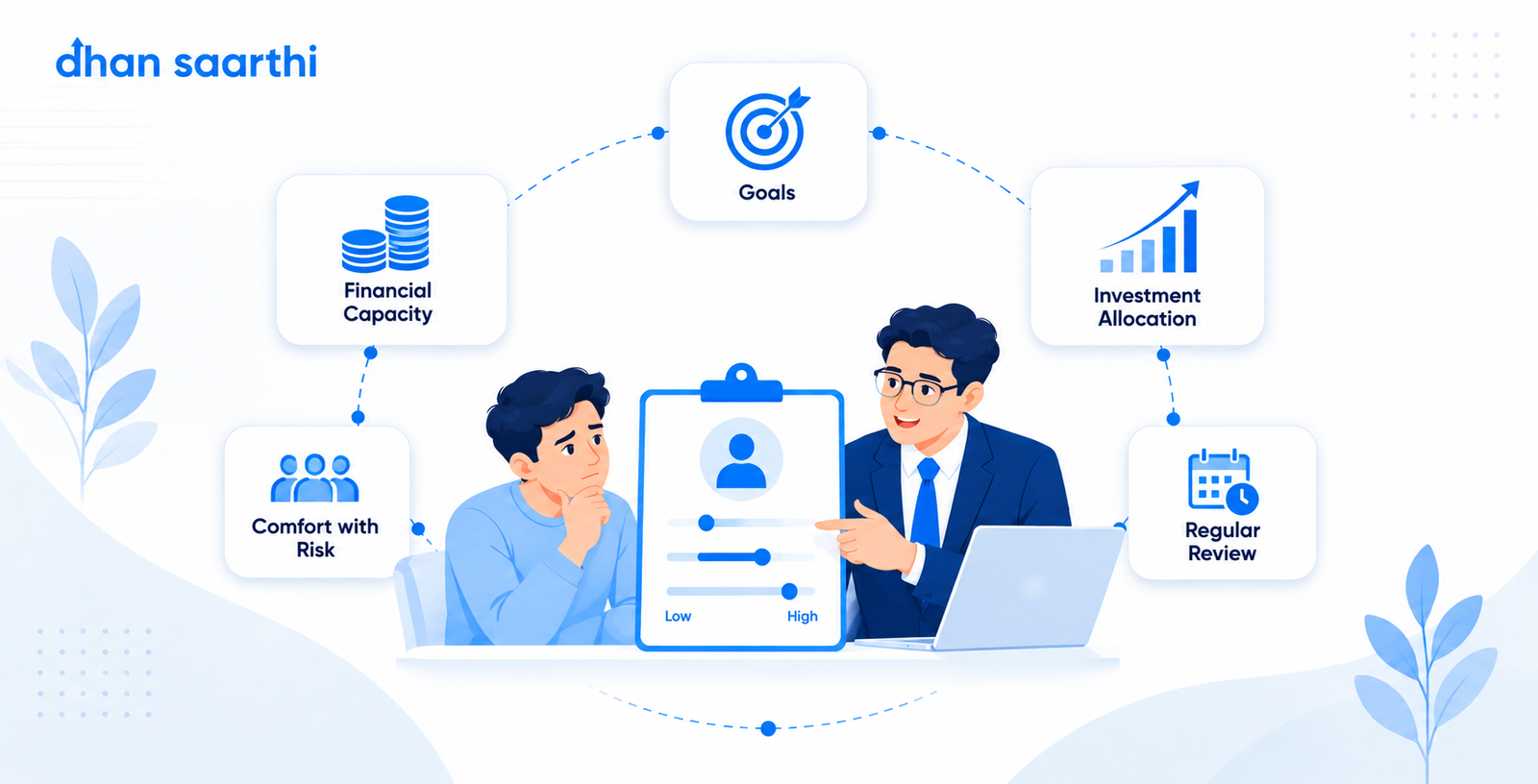
A typical questionnaire returns a single score — conservative, moderate, or aggressive — that attempts to capture two different things at once: how much risk a client's financial situation can actually absorb (risk capacity), and how much volatility the client is psychologically comfortable watching (risk willingness).
A salaried client in their early thirties with no dependents may have high risk capacity but still feel visibly anxious watching a 15% drawdown. A client nearing retirement may claim comfort with aggressive funds but has very little time to recover from a poor sequence of returns. Collapsing both dimensions into one number often produces a recommendation that satisfies neither the math nor the client's nerves.
3. The profile is built around the client, not the goal
Most questionnaires profile a person, not a purpose. But the same client may be saving for a child's education in eight years, a retirement corpus in twenty-five years, and an emergency reserve that needs to stay liquid at all times. Applying one risk score — usually whichever the client's overall comfort level dictates — across all three goals means either the long-term goal is under-allocated to equity, or the short-term goal is carrying volatility it cannot afford.
4. Family and HNI portfolios get profiled like single accounts
For family households or HNI relationships spread across multiple account holders, generations, and goals, collapsing everything into a single risk profile misses the bigger picture. A conservative spouse and a child with a long investment horizon often need meaningfully different allocations within what looks, on paper, like one family relationship.
5. The profile is rarely revisited
Once filed, the profile typically is not revisited unless the client raises the topic — after a job change, an inheritance, a market scare, or as a goal deadline approaches. By the time it is updated, the portfolio may have already drifted well away from what is appropriate.
Why This Gets Expensive for Mutual Fund Distributors, Not Just Clients
1. It surfaces during the worst possible moment
A mismatched risk profile rarely creates a problem in calm markets. It surfaces exactly when communication matters most — during a correction, when the client's actual emotional tolerance, not the score on file, determines whether they hold, panic-sell, or call you to ask hard questions about why this happened in a fund they understood to be reasonably safe.
"The advisor said it was a moderate-risk fund. I did not expect it to fall this much."
— The conversation that costs clients trust and Mutual Fund Distributors AUM.
2. It weakens the case against direct plans
When a client feels their portfolio does not match what they signed up for, the natural next question is about what value the advisor relationship is adding. A risk profile filled once and never revisited is a hard thing to defend when a client is weighing your service against the cost difference of moving to direct plans.
3. It generates redemptions that could have been anticipated
Many redemption conversations during a downturn are not really about returns — they are about a client discovering their actual risk tolerance is lower than their stated score. A profiling process that surfaces this before the money is invested prevents a much harder conversation after.
A Practical Framework for Fixing Risk Profiling
1. Separate risk capacity from risk willingness
Treat these as two separate inputs rather than one blended score. Where they conflict, let the more conservative of the two guide the final allocation.
| Risk Capacity | Risk Willingness |
|---|---|
| Determined by income, time horizon, liquidity needs, and existing assets | Determined by the client's psychological comfort with watching portfolio volatility |
| A measure of what the financial plan can absorb | A measure of what the client can emotionally sustain without reacting |
| Can usually be assessed with reasonable objectivity | Often overstated by clients until tested by an actual market fall |
| Changes with income, life stage, and goal proximity | Changes with market experience and familiarity with volatility |
2. Profile by goal, not just by client
Where a client has multiple goals with different time horizons, treat each goal as its own mini risk profile rather than averaging everything into one client-level score. A retirement goal twenty years away can usually carry meaningfully more equity exposure than an education goal six years out, even for the same client. This distinction also makes portfolio review conversations sharper — you are explaining the allocation in terms of the goal, not just a generic risk label.
3. Build a revisit cadence into your service calendar
Set fixed triggers for re-profiling: at minimum an annual review, plus event-based triggers such as a job change, a large inflow or windfall, an approaching goal deadline, or a market move significant enough to test the client's stated tolerance. This shifts risk profiling from an onboarding artifact into an ongoing part of your servicing practice.
- Annual review — Revisit the profile as part of every yearly portfolio review call
- Job change or income shift — A significant income change affects risk capacity directly
- Approaching goal deadline — Review and de-risk the relevant bucket as the horizon shortens
- Large inflow or inheritance — New money needs fresh profiling, not automatic replication of the existing allocation
- Major market move — Use a significant correction or rally as an opportunity to check whether the client's stated tolerance held up
4. Document the conversation, not just the score
A score alone does not explain why a client answered the way they did. Brief notes alongside the formal questionnaire — "client mentioned panicking during a past market fall" or "client has a conservative spouse who reviews statements jointly" — give you context that is far more useful in a future market conversation than a number on a form.
5. Use the profile actively in portfolio construction and review conversations
The profile should show up explicitly when you recommend a fund or review a portfolio, not just at onboarding. "This fund fits your profile because your education goal has a six-year horizon and you have indicated a preference for lower short-term volatility" is a stronger sentence than a silent assumption that the original questionnaire still holds.
Where Technology Helps — Without Replacing Your Judgment
As a client book grows, manually checking each portfolio against its original risk profile becomes increasingly impractical. Tools that flag where current allocations have drifted from the stated risk profile let you see the full picture across your book quickly, so you know which conversations to prioritise before a market event forces those conversations anyway.
This does not replace the advisor's role. It means you walk into the conversation already knowing where the gap is, with a point of view on what to do about it — rather than discovering it from the client first.
How Dhan Saarthi Helps Mutual Fund Distributors With Client Risk Profiling
Dhan Saarthi is built specifically for Indian Mutual Fund Distributors — and risk profiling is a core part of what the platform addresses. Here is how it supports Mutual Fund Distributors across the risk profiling process in practice.
📊 Portfolio Health Analysis
Dhan Saarthi's Portfolio Health Analysis tool scans your client book and surfaces portfolios where the current allocation has drifted meaningfully from the client's stated risk profile. Instead of discovering mismatches during a market fall, you see them on your dashboard — in time to act.
🎯 Goal-Level Portfolio View
Rather than treating each client as a single aggregated account, Dhan Saarthi allows you to view and manage a client's portfolio by goal — so a client's education corpus, retirement corpus, and emergency reserve can each be evaluated against their own appropriate risk parameters, not one blended score.
🔔 Drift Alerts Across Your Book
As markets move, asset allocations drift. Dhan Saarthi tracks these shifts at the portfolio level and flags clients whose current allocation has moved outside their risk-appropriate range — prompting you to review and rebalance before the client has cause to question why it happened.
🗂️ Centralised Client Relationship Context
Dhan Saarthi keeps client information, goal details, and portfolio data in one place, so the context you need for a risk profiling conversation — income, goals, investment horizon, existing allocation — is accessible before you pick up the phone, not assembled on the fly during the call.
📅 Review Calendar and Service Cadence
Dhan Saarthi supports a structured annual review cadence, helping Mutual Fund Distributors schedule and track portfolio review touchpoints across their client book. This makes revisiting the risk profile a built-in step in the review conversation, rather than something that only happens when a client requests it.
📋 Mutual Fund Distributor-Facing Dashboard Built for Scale
For sub-distributors and ARN holders managing large client books, Dhan Saarthi's advisor dashboard gives a book-level view — so identifying which clients are due for a risk profile review, or which portfolios are most misaligned, does not require opening each account individually.
Find the Mismatches Before Your Clients Do
If you are managing more than a handful of client portfolios, manually comparing each one against its original risk profile is not practical at scale. Dhan Saarthi's Portfolio Health Analysis tool helps you quickly identify where a client's current allocation has drifted from their stated risk profile — so you know which conversations to have, and when.
Book a demo with Dhan SaarthiConclusion
Risk profiling only earns its place when it is treated as an ongoing conversation rather than a one-time form — one that follows each goal, gets revisited on a set cadence, and shows up explicitly when you construct or review a portfolio. Get that right, and it becomes one of the strongest reasons a client stays with you when markets get uncomfortable.