SIP cancellations don't happen in a single moment. They follow a trail — five predictable trigger points that appear weeks or months before a client hits the cancellation button. Most Mutual Fund Distributors miss these signals entirely. This guide maps each trigger and gives you a practical intervention for each one.
A SIP Cancellation Is Never Just About the SIP
When a client cancels a SIP, the immediate explanation is usually one of these: "markets are down," "I need the money," or "I'm not seeing returns." But these are symptoms, not causes.
Underneath every SIP cancellation is a breakdown in one of three things: trust, communication, or relevance. The client no longer believes the SIP is working for them — or worse, they no longer feel their advisor is working for them.
For a Mutual Fund Distributor, a cancelled SIP is a double loss. You lose the AUM contribution and the compounding effect it was building toward, and you often lose the client relationship soon after. SIP cancellations are rarely isolated — they're the first visible signal that a client is disengaging.
Why This Matters to Your Practice
A SIP book that looks healthy today can deteriorate quietly if renewal rates are falling. By the time you notice the numbers, the relationship work required to recover is far harder than the early intervention would have been.
The good news: most SIP cancellations are preventable. They follow a pattern. Below are the five trigger points that tend to precede a client's decision to cancel — and the intervention that works for each.
The Five Trigger Points — And What to Do at Each
Trigger 01
The Market Has Fallen and the Client Has Gone Quiet
A client who used to check their portfolio regularly suddenly stops. No messages, no calls, no questions. This silence is often misread by advisors as calm. It usually isn't.
When markets fall and a client goes quiet, it typically means one of two things: they're processing worry on their own, or they've already decided to stop the SIP and are waiting for the "right moment" to tell you. Either way, the window to intervene is short.
Silence during a market correction is not client confidence — it's disengagement in progress.
Intervention
Reach out proactively within the first 10 days of a significant market fall. Don't wait for the client to contact you. A brief WhatsApp message or a short call — not a product update, but a check-in — reassures the client that you're watching their portfolio, not just their account. Acknowledge the market situation plainly. Remind them what the SIP is for. The message doesn't need to be long. It needs to arrive before the cancellation thought solidifies.
Trigger 02
The Client Starts Asking "How Much Have I Made So Far?"
This question sounds innocent. It isn't. When a client asks about total returns or absolute gains — especially for a SIP that's less than three years old — they're usually measuring the investment against a short-term expectation, not the original goal.
This often happens after a friend mentions a fixed deposit, a colleague talks about a stock tip, or a family member questions why the client is investing in mutual funds. The client hasn't made a decision yet. But they're forming one.
Intervention
Treat this question as a re-orientation moment, not a data request. When a client asks about absolute returns, bring the conversation back to the original goal and timeline. If possible, show them what the XIRR looks like against what a fixed deposit or a savings account would have delivered over the same period. More importantly, ask: "The goal you set this SIP for — how far away is it now?" Reconnecting the SIP to a named goal significantly reduces the temptation to cancel it.
Trigger 03
A Life Event Has Changed the Client's Cash Flow
Job change, EMI increase, a child's school fee revision, a family medical expense, home renovation — any event that puts pressure on monthly cash flow is a direct SIP risk. The client may not tell you proactively. They often decide quietly to "pause for a few months" and never resume.
This is one of the most common and most preventable SIP cancellation triggers. It isn't about investment conviction — it's about cash flow management.
Intervention
Build a habit of annual or bi-annual financial check-ins with clients where you specifically ask about changes in income or expenses. If a client is facing temporary cash flow pressure, discuss reducing the SIP amount temporarily rather than cancelling it entirely. A ₹2,000 SIP maintained through a difficult period is far more valuable long-term than a ₹10,000 SIP cancelled and never restarted. Give the client a practical option — don't make cancellation the only easy choice.
Trigger 04
The Client Hasn't Heard From You in 3+ Months
A Mutual Fund Distributor who communicates only when there is something to sell is training clients to see the relationship as transactional. When that client doesn't hear from you for three months or more, they don't feel ignored — they stop thinking about you at all.
The danger here is that another financial product, a colleague's advice, or a direct plan comparison fills that silence. By the time you reconnect, the client's frame of reference has shifted.
Intervention
No client — regardless of portfolio size — should go three months without some form of proactive communication from you. This doesn't mean a formal review each quarter. A market note, a brief portfolio update, a reminder about an upcoming financial event, a relevant article — any touchpoint that demonstrates you're watching their interest is enough. Build a communication calendar and stick to it. The clients who cancel are disproportionately the ones who haven't heard from you.
Trigger 05
Someone Else Has Got the Client's Ear
A direct plan app, a friend who "manages his own portfolio," an insurance agent cross-selling equity-linked products, a relative who invested in a different scheme and is getting better returns — any of these can introduce doubt about whether a client's current SIP is the right choice.
This trigger is the hardest to detect because the conversation usually doesn't happen in front of you. The first sign is often a client asking questions they've never asked before: "Is there a version of this without commission?" or "My friend says he gets better returns with his portfolio."
Intervention
This is where your value proposition needs to be made visible, not implied. When a client raises comparisons, don't get defensive. Ask: "What is your friend comparing — the fund, the return period, or the strategy?" Often the comparison isn't apples-to-apples. More importantly, use this moment to remind the client of what you have done for them specifically — portfolio reviews, goal tracking, guidance during market falls. A client who can name the value you've added is far harder to poach than one who can't.
Your SIP Retention Protocol: What to Build Now
Knowing the five triggers is useful. Having a system that catches them early is what actually protects your SIP book.
Below is a basic SIP retention protocol that any Mutual Fund Distributor can build, regardless of practice size. The goal is to move from reactive (responding after a cancellation request) to proactive (intervening before the decision is made).
| Trigger Signal | Detection Method | Intervention Timing | Risk Level |
|---|---|---|---|
| Client goes quiet during market fall | No WhatsApp / call in 2+ weeks during a correction | Within 10 days of market fall | High |
| Client asks about absolute returns | Inbound query about "how much have I made" | At the time of the query | Medium |
| Life event changes cash flow | Annual / bi-annual financial check-in | Before the pressure becomes a decision | High |
| No communication for 3+ months | Communication log / calendar review | Before the 90-day mark | Medium |
| Client raises comparison / external influence | Inbound question about direct plans, other funds, or returns | At the time of the query | High |
💡 A SIP that has been paused is not automatically lost. Many clients who pause a SIP can be re-activated within 60–90 days if the advisor follows up with a specific conversation about restarting — not a generic nudge. The conversation should reference the original goal the SIP was set for.
Three non-negotiable habits for SIP retention
- ✓ Track every SIP in your book by vintage — SIPs under 18 months are the most cancellation-prone and need the most proactive communication.
- ✓ Build a 12-month communication calendar with at least one proactive touchpoint per client per quarter. Schedule it. Don't rely on memory.
- ✓ After every market correction, send a brief client communication within 10 days — even if it's just three sentences. Silence during volatility signals neglect.
How Dhan Saarthi Helps You Prevent SIP Cancellations
The five triggers above are well-defined — but catching them across a book of 100 or 200 clients is where manual tracking breaks down. The clients most at risk of cancelling are rarely the ones calling you. They're the ones who have quietly stopped engaging. By the time you notice, the decision is often already made.
Dhan Saarthi is built specifically to solve this problem for Mutual Fund Distributors. Here's what that looks like in practice:
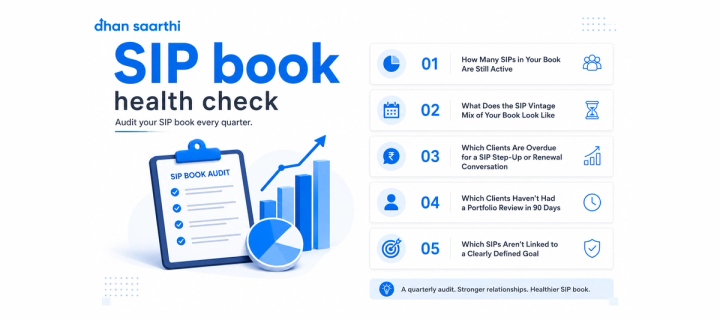
- ✓ SIP book visibility in one view. See the health of your entire SIP book — renewal status, SIP vintage, and at-risk SIPs — without manually pulling data client by client.
- ✓ Portfolio health flags. Dhan Saarthi surfaces clients whose portfolios haven't been reviewed recently, so you can prioritise outreach before disengagement sets in.
- ✓ SIP vintage tracking. Identify which SIPs in your book are under 18 months old — the highest-cancellation-risk segment — so you can give them the proactive communication they need.
- ✓ Client-level review history. Know exactly which clients haven't had a touchpoint in the last 90 days, so no one falls through the communication gap that precedes Trigger 4.
The goal is to give you the visibility to intervene at the trigger point — not after the cancellation request has already arrived.
Conclusion
SIP cancellations are rarely sudden — they follow five predictable triggers rooted in a breakdown of trust, communication, or relevance, and each one has a specific, timely intervention that can prevent it. Mutual Fund Distributors who track SIP vintage, maintain a proactive communication calendar, and reach out within days of a market fall or a silent client catch the disengagement before it becomes a cancellation request, protecting both the AUM and the relationship behind it.