Most investing conversations fail quietly. A client nods along, agrees to invest, and six months later cancels or switches because the investment was never anchored to anything real. Goal-based conversations fix this — but only if they're structured correctly. This guide gives you five practical scripts for the moments where goal-based investing conversations matter most.
Why Goal-Based Investing Conversations Matter More Than Product Talk
Ask a client why they're investing, and most will say something vague: "for the future," "to grow my money," or "because everyone does a SIP." None of these give you anything to hold on to when markets fall or when a client starts comparing returns with a friend's portfolio.
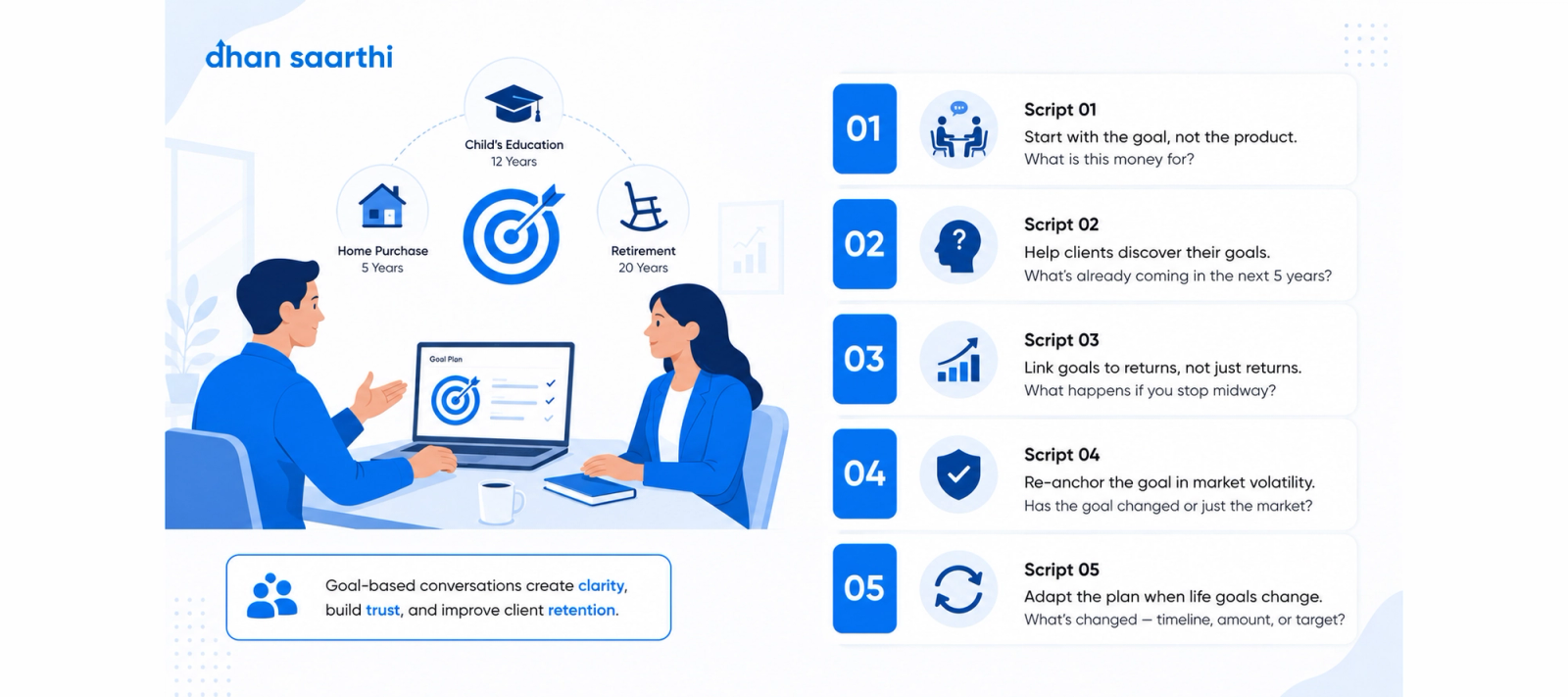
A goal-based conversation replaces a vague intention with a specific target — a child's education in 12 years, a house down payment in 5 years, retirement income in 20 years. Once an investment is attached to a named goal with a timeline, the entire relationship changes. The client stops asking "is this fund doing well?" and starts asking "am I on track for what I actually need?"
For a Mutual Fund Distributor, this shift matters commercially as much as it matters to the client. A goal-anchored client is far less reactive to short-term volatility, far less likely to compare you unfavourably against a direct plan app, and far easier to retain through a market cycle.
Why this matters to your practice: Clients rarely leave because a fund underperformed. They leave because they no longer remember why they were investing in the first place. Goal-based conversations are the single most effective tool for preventing that memory loss.
Below are five conversations that come up constantly in a Mutual Fund Distributor's practice — and a practical script for each.
5 Goal-Based Investing Conversation Scripts for Mutual Fund Distributors
Script 01
How to Start a Goal-Based Investing Conversation With a New Client
Most first meetings jump straight to risk appetite and fund categories. That's a mistake. If you start with products, the client evaluates you on returns for the rest of the relationship. If you start with goals, the client evaluates you on outcomes.
A first meeting that opens with fund performance sets the wrong frame for everything that follows.
What to Say
Open with: "Before we talk about where to invest, let's talk about what you're investing for. If you had to name the two or three things this money needs to do for you — over the next 5, 10, or 20 years — what would they be?" Write down what the client says, in their own words. This becomes the reference point for every future conversation, especially during a market fall.
Script 02
What to Say When a Client Doesn't Have a Clear Financial Goal
Not every client walks in with a defined goal. Some simply want to "start investing" or "not keep money idle in a savings account." Pushing them to invent a goal on the spot usually produces a generic answer that won't hold up later.
The better approach is to work backward from the client's life stage rather than forward from an abstract question.
What to Say
Ask: "Let's set aside the word 'goal' for a moment. In the next 5 years, is there anything you already know is coming — a wedding in the family, a home purchase, a career change? And beyond that, what does your life look like at 50 or 60?" Most clients can answer this even when they can't answer "what is your financial goal?" directly. Convert the answer into a named goal with an approximate timeline before moving to product selection.
Script 03
How to Explain Goal-Based Investing to a Client Who Only Wants High Returns
Some clients will resist the goal conversation entirely: "Just tell me which fund gives the best return." This client isn't wrong to want good returns — but a return number without a purpose attached to it is very easy to abandon the moment a better-looking number appears elsewhere.
The task here is not to argue against returns. It's to show the client that the goal conversation actually protects the return they're chasing.
What to Say
Say: "I want you to get the best possible return too. But the biggest risk to your return isn't fund selection — it's stopping midway. Investors who tie their money to a specific goal stay invested through the years that matter most. Let's pick the goal first, and I promise the fund conversation will be just as sharp." This reframes the goal conversation as return-protection, not return-avoidance.
Script 04
How to Reconnect a Client's Investment to Their Goal During Market Volatility
This is the moment the earlier groundwork gets tested. When markets fall and a client calls in worry, reciting portfolio performance numbers rarely calms them down — it can make the worry worse.
The most effective response pulls the client's attention away from the market and back to the goal and timeline they named at the start.
What to Say
Say: "I understand this is worrying to watch. Let's step back for a second — the goal we set this investment up for is still [X] years away. Short-term market movement doesn't change that timeline, and reacting to it now is far more likely to hurt the goal than help it. What's changed for you personally — has anything about the goal itself shifted?" This question does two things: it calms the immediate reaction, and it checks whether the underlying goal is still accurate.
Script 05
How to Handle a Goal Conversation When a Client's Life Goal Has Changed
Goals aren't static. A child decides to study in a different field, a client changes jobs, a retirement timeline moves earlier or later. If the goal quietly changes and the investment plan doesn't, the client eventually notices the mismatch — usually as a complaint, not a conversation.
Treat a changed goal as routine, not as a crisis. The client should feel that adjusting the plan is expected, not a sign that something went wrong earlier.
What to Say
Say: "Life plans change, and that's completely normal — it just means we adjust the numbers, not throw out the plan. Tell me what's changed, and let's work out whether the timeline, the monthly amount, or the target itself needs to move." Schedule a goal review at least once a year with every client so this conversation happens proactively rather than only when the client raises it themselves.
How to Build a Goal-Based Conversation Protocol for Your Client Book
Knowing the five scripts is useful. Having a simple system that ensures they actually happen — with every client, at the right moment — is what turns this into a retention advantage rather than a one-time technique.
| Conversation Moment | When to Use It | Key Question to Ask | Risk if Skipped |
|---|---|---|---|
| First client meeting | Before discussing any fund or product | What is this money for? | High |
| Client has no defined goal | During onboarding, before product selection | What's already coming in the next 5 years? | Medium |
| Client focuses only on returns | Whenever return comparisons come up | What happens to this return if you stop midway? | Medium |
| Market volatility or client worry | Within days of a significant market fall | Has the goal itself changed, or just the market? | High |
| Client's life goal has changed | Annual goal review, or when the client mentions a change | What's changed — the timeline, the amount, or the target? | Medium |
💡 A goal that hasn't been reviewed in over a year is a goal that's probably out of date. Build the annual goal review into your calendar the same way you would a portfolio review — it protects the conversation you've already built with the client.
3 Non-Negotiable Habits for Goal-Based Investing Conversations
- ✓ Write down every client's stated goal, in their own words, at the first meeting. Don't rely on memory or a generic template answer.
- ✓ Review every client's goal at least once a year, and immediately after any life event they mention to you.
- ✓ During market volatility, lead every conversation with the goal and timeline before touching on portfolio performance.
How Dhan Saarthi Helps You Run Goal-Based Conversations at Scale
These scripts work well for one client at a time. The real challenge is running this consistently across a full client book, where a goal noted down at the first meeting is just as easily forgotten a year later. Dhan Saarthi's goal planning tool gives every client a defined goal record — target, timeline, and required amount — sitting alongside their portfolio, so the goal you set in Script 01 stays visible at every review that follows, not just the first one.
This is also what makes Scripts 04 and 05 easier to run well. When a client calls in worry during a market fall, or mentions a life change that shifts their goal, you can pull up exactly where they stand against the goal instead of relying on memory or an old note. The goal planning tool is built to keep that reference point current, so the conversation you have with a client on day one doesn't quietly go out of date by year three. See it firsthand with a walkthrough of the platform, built around exactly this kind of goal-tracking workflow.
Build Stronger Goal-Based Conversations With Your Clients
Book a free demo and see how Dhan Saarthi keeps every client's goal — and every goal-based conversation — grounded in real, trackable numbers.
Book a Free Demo of Dhan SaarthiConclusion
Goal-based investing conversations aren't a soft add-on to a Mutual Fund Distributor's practice — they're what keeps a client invested through the exact moments when they're most tempted to stop. A named goal with a timeline gives every future conversation, especially the difficult ones, something concrete to return to.
Start with the first meeting, revisit the goal at least once a year, and lead with the goal — not the fund — whenever markets get uncomfortable. The scripts in this guide are a starting point. The habit of using them consistently is what actually protects the client relationship.