An annual client review meeting isn't a formality — it's one of the highest-leverage conversations a Mutual Fund Distributor has all year. Done well, it renews trust, catches portfolio drift early, and gives the client a clear reason to stay invested for another year. Skipped or rushed, it quietly costs more client retention than any single market correction. Here is a practical, step-by-step framework you can use for every client on your book.
Why Do Annual Client Review Meetings Get Skipped? Here's What It Costs You
Most Mutual Fund Distributors don't skip review meetings on purpose. They get pushed aside by servicing requests, onboarding new clients, and the day-to-day work of running a practice. The clients who get a formal review each year are usually the largest few. Everyone else gets an occasional call or a WhatsApp update when markets move.
The problem is that clients don't experience this as a scheduling issue. They experience it as being forgotten. A client who hasn't sat down with you in over a year has no structured way of knowing whether their portfolio is still aligned to their goal, whether their risk appetite has changed, or whether they're paying for a relationship that isn't actively managing anything for them.
Why this matters to your practice: A missed annual review doesn't just create a gap in service — it creates a gap in the client's understanding of your value. That gap is exactly where direct plan comparisons, competing advisors, and disengagement quietly take root.
A structured annual review meeting closes that gap. Below is a framework you can apply consistently, whether the client's portfolio is modest or substantial.
How to Prepare for a Client Portfolio Review Meeting
A review meeting is only as useful as the preparation behind it. Walking in without a clear picture of the client's portfolio, goals, and history turns the conversation into a generic check-in rather than a meaningful review.
Before every annual review, prepare the following:
- ✓ A consolidated view of the client's current portfolio, including allocation across schemes and asset classes.
- ✓ Performance since the last review, shown against the original goal timeline — not just absolute returns.
- ✓ A quick check on whether the current asset allocation still matches the client's stated risk profile.
- ✓ Notes on any life changes you're aware of — a new job, a child's education stage, an upcoming large expense.
- ✓ Two or three specific talking points for this client — not a generic market update you'll repeat to everyone.
This preparation is what separates a review that feels personal from one that feels like a formality the client sits through out of politeness.
Annual Client Review Meeting Agenda: A Step-by-Step Guide
Step 01
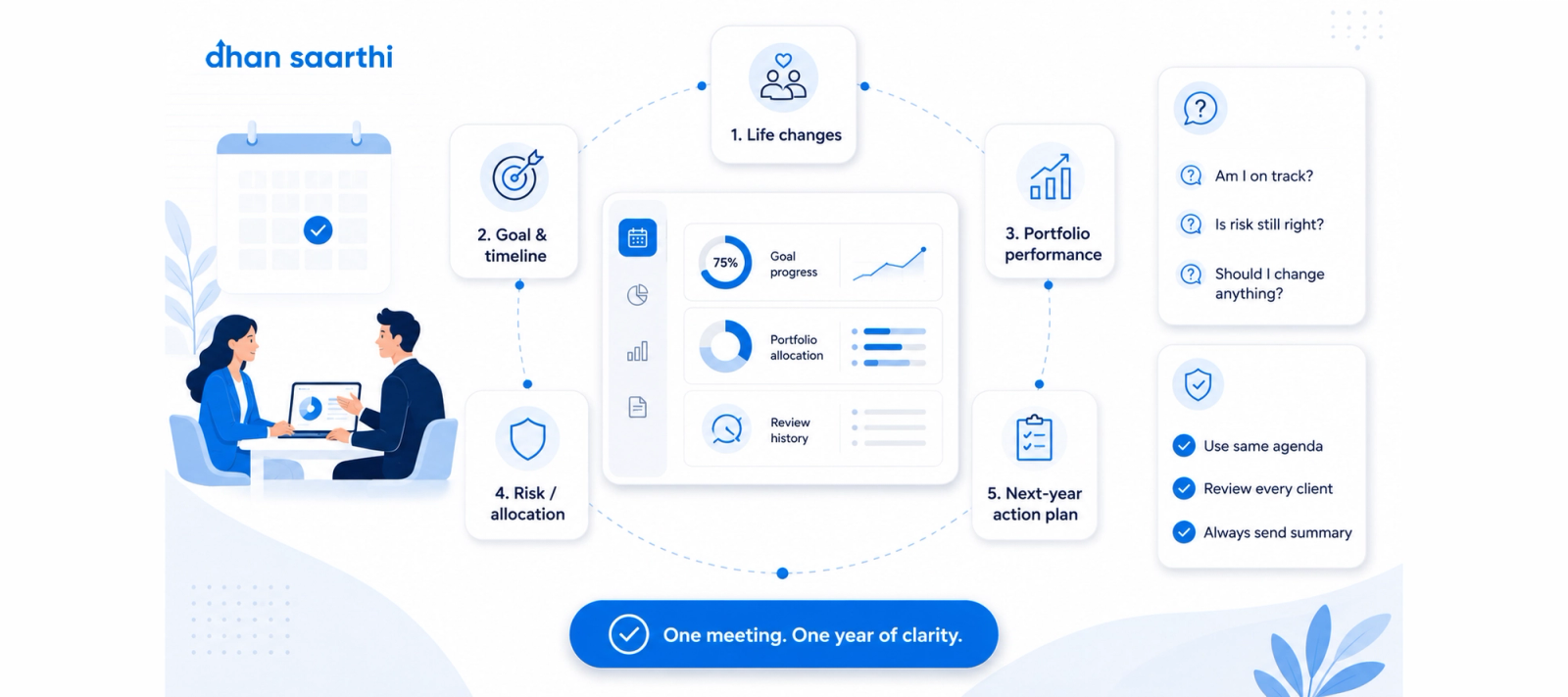
Start With Their Life, Not Their Portfolio
Opening a review meeting with fund performance sets the wrong tone. It signals that the meeting is about the product, not the person. Clients remember reviews where they felt heard before they felt sold to.
A portfolio review that starts with numbers feels like an audit. One that starts with the client's life feels like a relationship.
What to do
Open with two or three simple questions: has anything changed in their income, family situation, or major upcoming expenses since the last review? This isn't small talk — the answers directly affect whether the current plan still fits.
Step 02
Revisit the Original Goal and Timeline
Clients rarely remember the exact goal a scheme or SIP was set up for. Over a few years, the original purpose — a child's education, a home down payment, retirement — fades into the background, and the portfolio starts being judged on returns alone.
Restating the goal before discussing performance changes the entire frame of the conversation.
What to do
State the goal out loud: "This portfolio was built for your daughter's higher education in 2032." Then ask if the goal or the timeline has shifted. Anchoring the review to a named goal makes every number that follows meaningful rather than abstract.
Step 03
Walk Through Portfolio Performance in Context
Once the goal is on the table, performance can be discussed against it — not in isolation. A client comparing their returns to a colleague's stock tip is reacting to noise. A client comparing their progress to their own goal timeline is having a genuinely useful conversation.
This is also the moment to be transparent about underperforming schemes, if any, rather than glossing over them.
What to do
Show progress as "how far along toward the goal," not just percentage returns. If a scheme has lagged, say so plainly and explain what you're watching or recommending, rather than waiting for the client to notice and ask.
Step 04
How to Check If Asset Allocation Still Matches Risk Appetite
A client's risk appetite when they started investing is rarely the same a few years later. A job loss, a new dependent, an approaching goal date, or simply age can all shift how much risk a client should reasonably be carrying — even if they haven't said anything about it.
Portfolios also drift on their own as different asset classes grow at different rates, quietly changing the risk profile without anyone deciding it should.
What to do
Compare the current allocation against the client's last recorded risk profile. If the goal is now closer than it was — say, within three years — flag whether it makes sense to gradually reduce exposure to more volatile assets.
Step 05
How to Address Direct Plan Comparisons and Client Questions Head-On
Many clients carry an unspoken question into the review: is a direct plan, or a friend's self-managed portfolio, doing better than what they have? If you don't raise it, it stays unspoken and unresolved — and resurfaces later as doubt.
Raising it yourself, in a factual and non-defensive way, is far more effective than waiting for the client to bring it up.
What to do
Ask directly: "Have you come across any comparisons with direct plans or other portfolios recently?" Use the answer to explain the specific work you've done for them over the year — reviews, rebalancing, guidance during volatility — rather than a general pitch about advisor value.
Step 06
Close With a Written Action Plan and the Next Review Date
A review meeting that ends without a clear next step is easy for the client to forget within a week. Whatever was discussed — a rebalancing decision, an increase in SIP amount, a new goal added — needs to be written down and shared, not left as a verbal understanding.
The date of the next review should also be fixed before the meeting ends, not left as "we'll connect sometime next year."
What to do
Send a short written summary within 48 hours — what was discussed, what will change, and the confirmed date for the next review. This single habit is what turns a one-off meeting into an ongoing, visible process the client can trust.
Client Review Meeting Checklist: Before, During, and After
Use this as a quick reference to keep every review meeting consistent, regardless of which client or how large the portfolio.
| Phase | Action | Timing | Priority |
|---|---|---|---|
| Before | Pull consolidated portfolio view and goal-linked performance | 2–3 days before the meeting | High |
| Before | Note any known life changes since the last review | 2–3 days before the meeting | Medium |
| During | Restate the goal before discussing performance | First 5 minutes | High |
| During | Ask directly about comparisons and direct plan questions | Midway through the meeting | Medium |
| After | Send written summary and confirm the next review date | Within 48 hours | High |
💡 Schedule the following year's review before the client leaves the room or hangs up the call. Reviews that are left to be "scheduled later" are the ones most likely to slip by six months or get skipped entirely.
3 Habits That Make Client Review Meetings Consistent
- ✓ Build a review calendar covering your entire client book, not just your top clients by portfolio size.
- ✓ Use the same agenda structure for every client so nothing important gets missed under time pressure.
- ✓ Always send a written summary after the meeting — a verbal-only understanding is easy for clients to forget.
How Dhan Saarthi Helps You Run Better Client Review Meetings
The framework above is straightforward for one client. Running it consistently across a full book of clients — with accurate, up-to-date information for each one — is where most Mutual Fund Distributors run out of time.
Dhan Saarthi is built to close that gap, so review meeting preparation takes minutes instead of hours and the meeting itself can focus on the conversation, not on assembling data. In a short demo, the team can show you:
- ✓ Consolidated client reports. How to generate a clear, presentable portfolio report for each client ahead of the review, without manually compiling data across schemes.
- ✓ Goal-linked progress views. How to show clients their portfolio tracking against the goal it was built for, not just raw performance numbers.
- ✓ Review history tracking. How to see exactly when each client was last reviewed, so no one on your book goes a year — or more — without a formal conversation.
- ✓ Faster meeting preparation. How the platform fits into your existing review process, so you spend less time pulling data together and more time on the conversation that retains the client.
The easiest way to see whether this fits your practice is a short demo with the Dhan Saarthi team, walked through against your own client book.
See How Dhan Saarthi Fits Your Review Process
Book a short demo and see how Dhan Saarthi can help you prepare consolidated, goal-linked client reports before every review meeting.
Book a Demo with Dhan SaarthiConclusion
The annual client review meeting is one of the few structured moments in a Mutual Fund Distributor's calendar where trust is either reinforced or quietly eroded. A rushed or skipped review doesn't just leave a gap in service — it leaves the client to draw their own conclusions about whether the relationship is still worth it.
A consistent, well-prepared review — one that starts with the client's life, reconnects the portfolio to their goal, and ends with a written next step — is a small, repeatable habit that compounds into stronger retention across an entire book of clients.