A Mutual Fund Platform isn't just where you log transactions. It's the system your entire practice runs on — client visibility, reporting, onboarding, compliance, and the day-to-day experience your clients associate with you. Choosing the wrong one is expensive in ways that don't show up until months later. This guide breaks down exactly what to check before you commit.
Choosing a Mutual Fund Platform Is a Business Decision, Not Just a Tool Decision
Most Mutual Fund Experts pick a platform the way they'd pick any software — based on a demo, a referral, or whatever a colleague happens to be using. That approach works fine until the practice grows past a certain size. Then the gaps start to show: client data scattered across spreadsheets and apps, reports that take hours to compile, onboarding that frustrates new clients before the relationship even begins.
A Mutual Fund Platform touches nearly every part of how you run your practice — how quickly you onboard a client, how confident you feel about data security, how easily you can show a client their portfolio during a review call, and how much manual work sits between you and a scaled-up client book.
Switching platforms later is disruptive. Client data has to move, habits have to be relearned, and there's usually a period where nothing works quite as smoothly as before. That's why the evaluation before you choose matters more than most Mutual Fund Experts give it credit for.
Why this matters to your practice: A platform that looks capable in a sales demo can behave very differently once your full client book, your reporting cadence, and your actual day-to-day workflow are running through it. The checks below are meant to be applied before onboarding your book — not discovered after.
Below are the checks that matter most, in the order most Mutual Fund Experts encounter them during evaluation — from day-one usability to long-term scalability.
What to Check Before Choosing a Mutual Fund Platform
Check 01
Does the Platform Show Your Entire Client Book in One Place?
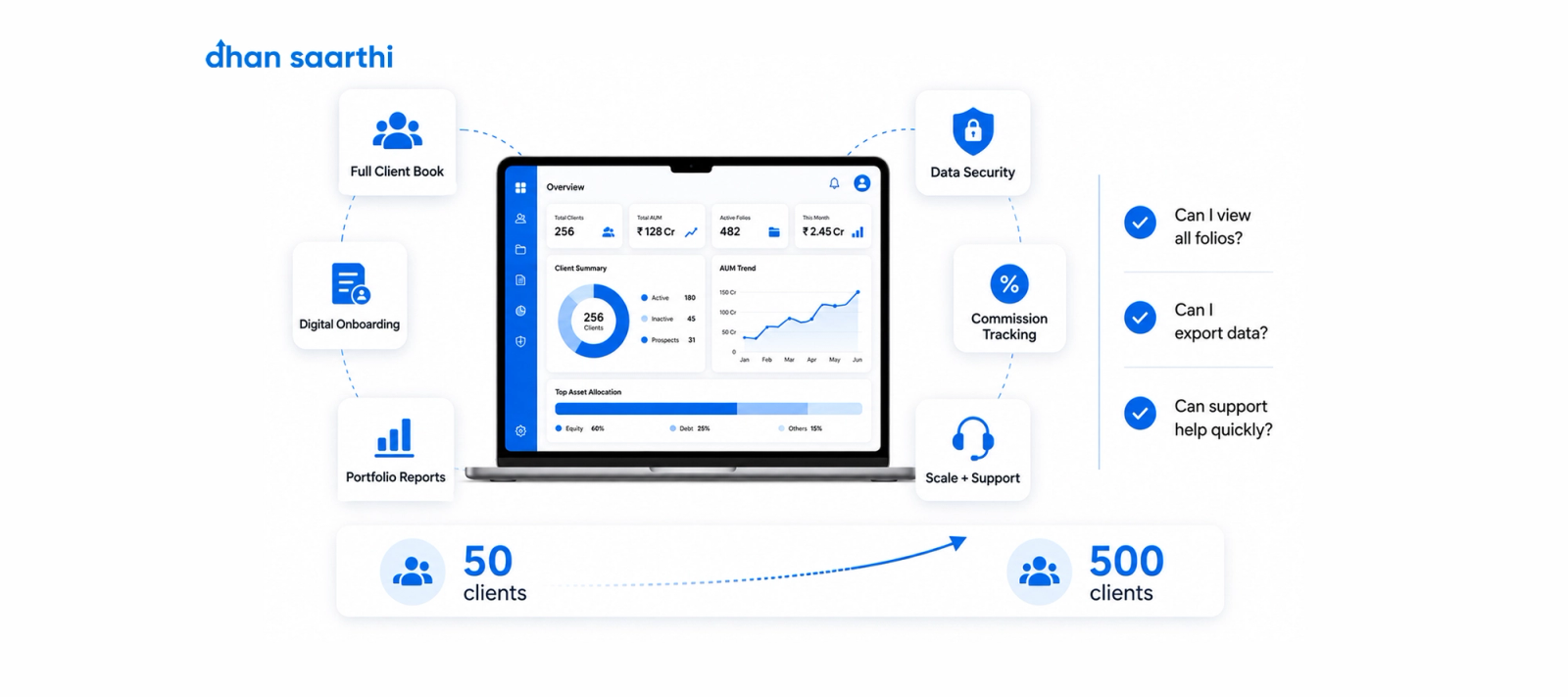
If you're managing client details across a mix of registrar statements, spreadsheets, and messaging apps, a Mutual Fund Platform's first job is to bring all of that into a single view — every client, every folio, every SIP status, without you having to piece it together manually.
During a demo, don't just ask if this is possible. Ask to see it with a client book of a realistic size. A platform that looks clean with five sample clients can behave very differently with two hundred real ones.
What to ask
Can I see my full client book, family-linked folios, and SIP renewal status on one screen — without exporting to Excel first? If the answer requires a workaround, note it. Workarounds during a sales demo tend to become daily friction later.
Check 02
How Easy Is Client Onboarding on the Platform?
Onboarding is the first real experience a new client has with your practice. A clunky, paperwork-heavy onboarding process reflects on you — not on the platform vendor. This is one of the areas where the gap between platforms is widest.
Digital onboarding capability, KYC handling, and how much back-and-forth a client has to go through before their first investment is live all directly affect how many prospective clients actually convert.
What to ask
Walk through the exact onboarding steps a new client would go through, start to finish. Count the steps. Ask what happens if a client drops off midway — can you resume where they left off, or does the process restart? (Specific KYC and regulatory workflow requirements should be verified against current SEBI and AMFI guidelines before you rely on them.)
Check 03
Does the Platform Send Automatic Portfolio Reports to Clients?
Client reporting is one of the most visible parts of the value you provide — and one of the easiest things to fall behind on when it's manual. If generating a portfolio report for a client review means pulling numbers by hand, that's time you're not spending on the conversation itself.
Check whether reports can be generated automatically, whether they're formatted in a way that's actually useful in a client conversation, and whether you can customise them or if they're rigid templates.
What to ask
Ask for a sample client-facing report generated in real time, not a pre-built showcase version. See how long it actually takes and how much of it is editable versus fixed.
Check 04
How Secure Is Client Data on the Platform?
You're handling sensitive financial and personal information for every client in your book. If a platform is vague about how that data is stored, who has access to it, and what happens to it if you ever move to a different provider, treat that as a warning sign — not a technicality to skip over.
This is also a trust question with your clients. If a client ever asks how their data is protected, you should be able to answer with confidence, not a shrug.
What to ask
Ask directly: where is client data stored, who can access it internally, and can I export my full client data if I ever need to leave? A platform confident in its own answer will not hesitate on this question. (Data protection and storage obligations should be checked against current applicable regulations — this varies and should be verified, not assumed.)
Check 05
Is Revenue and Commission Tracking Transparent on the Platform?
Your business runs on revenue you can see clearly and reconcile without guesswork. A platform that makes it hard to track what you've earned across your book — by client, by scheme, by period — adds friction to something that should be straightforward.
This matters most at scale. A discrepancy that's easy to spot with twenty clients becomes very hard to catch with two hundred, unless the platform is built to surface it clearly.
What to ask
Ask to see the exact screen where you'd track your earnings across the full book. Can you filter it, export it, and reconcile it against what you'd expect for a given period?
Check 06
Can the Platform Support You as Your Client Book Grows?
A platform that works well for fifty clients doesn't automatically work well for five hundred. Some tools slow down, some require manual work that scales linearly with your book size, and some simply weren't built with growth in mind.
Also worth checking: how responsive is support when something goes wrong during a client-facing moment — mid-onboarding, mid-review call, or right before a deadline. Reliability and support quality tend to matter far more than they seem to during the initial sales conversation.
What to ask
Ask what support actually looks like — response time, channel (call, chat, email), and whether you get a dedicated point of contact or a generic queue. Ask another Mutual Fund Expert already using the platform, if possible, rather than relying only on the vendor's own answer.
Mutual Fund Platform Evaluation Checklist at a Glance
Six checks are easy to remember in principle, harder to apply consistently across every platform you compare. Use the table below as a quick reference while you evaluate options side by side.
| What to Check | Why It Matters | Risk If Skipped |
|---|---|---|
| Client book visibility | Determines daily efficiency and how fast you can act on a client's account | High |
| Onboarding ease | Directly affects how many prospects convert into active clients | High |
| Reporting quality | Shapes how clients perceive the value you're delivering | Medium |
| Data security | Protects client trust and your professional reputation | High |
| Revenue transparency | Lets you reconcile earnings without manual guesswork | Medium |
| Scalability and support | Determines whether the platform still works once your book doubles | Medium |
💡 Ask any platform you're evaluating for a reference from an existing Mutual Fund Expert with a client book similar in size to yours. A vendor confident in their product will connect you. Hesitation on this request is itself useful information.
Three checks you shouldn't skip, no matter how good the demo looks
- ✓ Test the platform with your actual client data volume, not a sample dataset — behaviour can change meaningfully at scale.
- ✓ Confirm what data export options exist before you commit — you want the ability to leave cleanly if the platform doesn't work out.
- ✓ Speak to at least one existing user of the platform who manages a book similar in size to yours, not just the vendor's sales team.
How Dhan Saarthi Helps Mutual Fund Experts Evaluate and Run Their Practice
Every check above comes back to one question: does the platform actually make your day-to-day practice easier, or does it just look capable in a demo? Dhan Saarthi is built around the checks that matter most to Mutual Fund Experts running a real client book.
Here's what that looks like in practice:
- ✓ One view of your entire client book. See every client, folio, and SIP status together, without switching between spreadsheets and portals.
- ✓ Structured digital onboarding. A guided onboarding flow designed to reduce drop-off and get new clients invested faster.
- ✓ Automated, review-ready client reports. Generate portfolio reports built for actual client conversations, not raw data dumps.
- ✓ Clear revenue visibility. Track what you've earned across your book without manual reconciliation.
- ✓ Built to scale with your practice. Designed to stay usable as your client book grows from tens to hundreds of clients.
Dhan Saarthi is built to support Mutual Fund Experts, not replace the relationship you've built with your clients. The goal is to remove the operational friction so you can spend more time on the conversations that actually grow your practice.
See How Dhan Saarthi Handles Your Client Book
Request a demo and evaluate Dhan Saarthi against the checklist above — with your own practice in mind.
Request a Demo on Dhan SaarthiConclusion
A Mutual Fund Platform is a long-term commitment, not a quick software pick. The checks that matter — client visibility, onboarding ease, reporting quality, data security, revenue transparency, and scalability — are the same checks that determine whether your practice runs smoothly or fights its tools every day.
Take the time to evaluate properly before you commit. A platform that passes these checks now should still be serving your practice well when your client book has doubled.