Running a meaningful portfolio health check for every client becomes unmanageable past 50–100 clients, which is why most Mutual Fund Distributors default to reviewing only the loudest clients while quiet accounts drift unnoticed. This article lays out a scalable system — a traffic-light triage model, a 5-point health scan, and a tiered review cadence — so every client gets checked at least once a year without turning your week into a marathon.
Why Manual Portfolio Reviews Break Down at Scale
Most Mutual Fund Distributors start with a personal, thorough review process — looking at each client's holdings, checking performance, and making notes. That works for 20 clients. It doesn't work for 150.
When manual reviews become unsustainable, advisors tend to fall into one of three patterns:
- 1. Reviewing only active clients — the ones who call, message, or recently transacted. Quiet clients get missed.
- 2. Reviewing reactively — only when a market event triggers panic calls. By then, the client is already anxious.
- 3. Deferring reviews entirely — telling yourself the markets are stable, clients aren't complaining, so there's nothing urgent to check.
All three are risk patterns. A client whose portfolio has drifted significantly from their goal allocation isn't going to call you — they'll just quietly switch to direct plans or stop adding to their SIPs.
The Real Cost of Skipped Reviews
Portfolio reviews aren't just a service quality measure. They're your earliest warning system for client churn. A client who feels unmonitored is a client who's already looking for alternatives.
The Traffic-Light Health Check Model
The most efficient way to review a large client book is to sort before you analyse. Not every client needs a deep review every quarter. Most clients need a quick signal — and only a subset need your full attention at any given time.
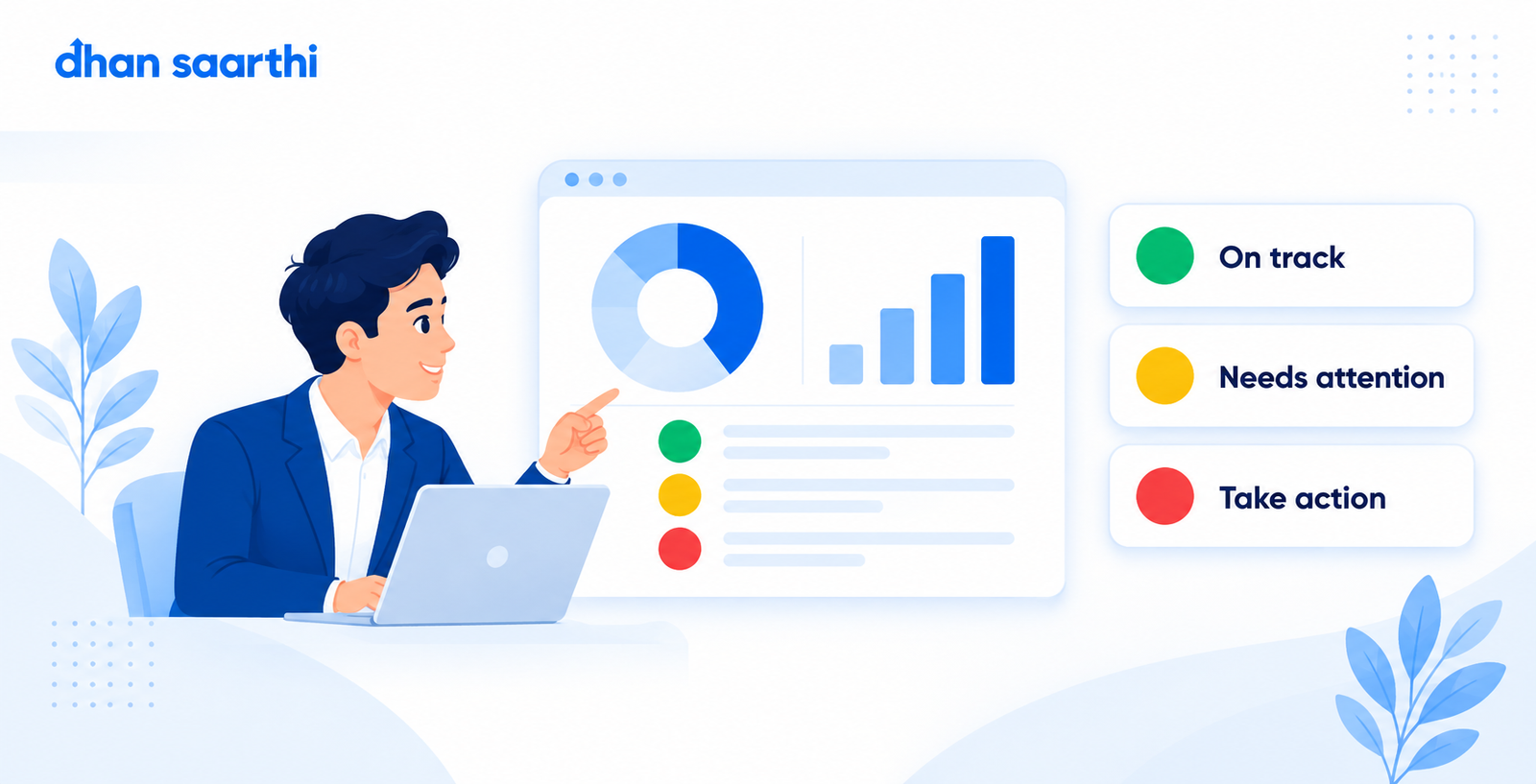
The traffic-light model assigns each client one of three statuses after a quick structured scan:
| Status | What it means | Action required |
|---|---|---|
| Green | Portfolio is on track. Goal alignment is intact, SIPs are active, no material drift or anomalies. | No immediate action. Schedule next review in 3–6 months. |
| Amber | One or more areas need attention — goal drift, SIP irregularity, allocation shift, or a pending life event. | Schedule a check-in call or meeting within 2–4 weeks. |
| Red | Material issue identified — significant goal drift, inactive SIP, risk mismatch, or portfolio underperformance against a specific goal. | Reach out immediately. Prepare a rebalancing or corrective plan. |
The goal of the initial scan is not to solve every problem — it's to sort your entire client book into these three buckets so you know where to spend your time this week.
The 5-Point Portfolio Health Scan
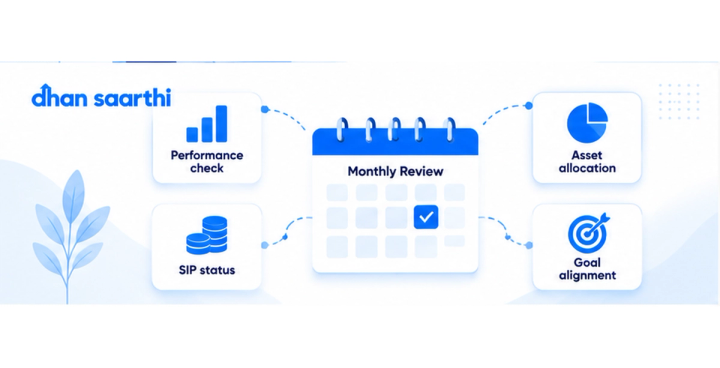
Each portfolio health scan should take 3–5 minutes per client at most. You're looking for signals, not writing a full report. Here are the five checkpoints that matter:
1
SIP Status
Are all SIPs active? When was the last instalment? Has any SIP lapsed, paused, or been cancelled in the last 90 days without a conversation with you? A lapsed SIP is almost always a signal — either a financial stress event or the beginning of disengagement.
2
Goal Alignment
Is the portfolio on track for its primary goal? If a client's target is ₹50 lakh for a child's education in 7 years, is the current corpus trajectory consistent with that? You don't need precision here — a directional check is sufficient. Is it clearly ahead, roughly on track, or visibly falling behind?
3
Asset Allocation Drift
Has the equity-to-debt ratio shifted meaningfully from the original agreed allocation? Market movements can drift a 60:40 portfolio to 75:25 over a bull run. If a conservative client's portfolio is now heavily equity-tilted, that's a misalignment you need to address — even if the client hasn't noticed.
4
Portfolio XIRR vs Benchmark
Is the overall XIRR acceptable relative to the client's time horizon and risk profile? You're not chasing fund performance here. You're checking whether the client's actual return experience — accounting for all their SIP instalments and redemptions — is reasonable given what they invested in and when. A significantly lagging XIRR needs a conversation.
5
Life Event Flag
Does this client have any upcoming life event — job change, retirement, child's admission, property purchase, marriage — that could affect their portfolio or SIP capacity in the next 6–12 months? These don't require action today, but they do require scheduling a conversation soon.
Time Guidance
With the right data in front of you, this 5-point scan should take 3–5 minutes per client. For 100 clients, that's 6–9 hours of focused work — ideally spread across the week, not compressed into one day.
How to Structure Your Review Week Without Dropping Everything Else
The biggest mistake Mutual Fund Distributors make is treating portfolio reviews as a block activity — they try to review everyone in one sitting, burn out halfway through, and abandon the process until the next market correction forces them back into it.
A sustainable review cadence works on a rolling basis. Here's one approach that works for a practice with 100–250 clients:
| Review Tier | Client segment | Frequency | Time per week |
|---|---|---|---|
| Tier A | Top 20% by AUM or relationship depth — typically HNI or long-standing clients | Quarterly full review | 2–3 clients per week |
| Tier B | Mid-tier clients — active, growing, or recently onboarded | Half-yearly health scan | 5–7 clients per week |
| Tier C | Long-standing stable clients — consistent SIPs, no life events, low-touch | Annual scan | 3–5 clients per week |
With this structure, you're reviewing roughly 10–15 clients per week — a manageable daily commitment that ensures every client in your book gets attention at least once a year, and your high-value clients get seen far more frequently.
Block time, don't borrow it
Protect a fixed review window every week — ideally the same time slot so it becomes a habit rather than a decision. Many advisors find that Tuesday or Wednesday mornings, before client calls begin, work well. Avoid Mondays (market open, reactive communications) and Fridays (close-of-week rush).
What to Do Once You've Flagged Amber and Red Clients
The traffic-light scan is only useful if it triggers action. Here's a simple protocol for each flag:
For Amber clients
Schedule a proactive check-in call — not a formal review meeting, just a 15-minute conversation. Acknowledge something specific:
"I was looking at your portfolio and noticed your equity allocation has moved up a bit — wanted to check in."
Clients respond well to this because it signals attentiveness without alarm. Use these conversations to also surface upcoming life events or changes in income. Amber flags are often early signals of something bigger.
For Red clients
Act quickly. Prepare a short summary of what you've found before the call — don't wing it. A client whose SIP has lapsed and whose portfolio has drifted significantly needs a specific, structured conversation, not a general check-in.
For red flags involving SIP cancellations or redemptions that you weren't consulted on, it's worth understanding the reason before jumping to solutions. Financial stress, a competing financial product, or simple disengagement all require different responses.
Documentation Note
For every red-flag conversation, document the outcome and any agreed actions — even informally. This protects you if a client later raises a dispute, and it helps you track whether the corrective action was taken.
Practice-Level Metrics Your Health Check System Should Feed
A well-run health check system gives you data not just about individual clients, but about your practice as a whole. Track these numbers monthly:
| Metric | What it tells you |
|---|---|
| SIP Active Rate | % of clients with at least one active SIP. A declining rate is an early practice warning. |
| Red-Flag Count | Number of clients in red status this month. Watch the trend, not just the number. |
| Reviewed % | % of clients reviewed at least once in the last 12 months. Target: 100%. |
| Avg. XIRR | Average portfolio XIRR across your book — a useful broad health signal (benchmark against relevant category returns). |
These metrics help you see trends before they become problems. A rising red-flag count over three consecutive months is a sign of either market stress or a gap in your client communication — and knowing which it is helps you respond correctly.
Making the Health Check Client-Facing — When It Adds Value
Not every health check needs to result in a client-facing conversation. For green clients, an internal note is sufficient. But for amber and red clients, consider sharing a simple one-page summary when you reach out.
A client-facing health check summary doesn't need to be elaborate. It should show:
- 1. Current portfolio value and invested amount
- 2. XIRR since inception
- 3. Goal progress — how far along toward the target corpus
- 4. One or two observations and recommended next steps
Clients who receive a proactive, structured summary from their advisor — even a brief one — are far less likely to feel unattended. This is also a meaningful differentiator from direct plan self-service, where the client gets data but no interpretation.
What Data You Need — and Where the Bottleneck Usually Is
The health check system described here is straightforward in theory but often breaks down in practice for one reason: data access. Running a 5-point scan manually, pulling data from multiple sources, takes far longer than the 3–5 minutes per client it should.
To run this at scale, you need a single view of each client's:
- 1. Consolidated portfolio across all AMCs and folios
- 2. Active and lapsed SIP status
- 3. Current asset allocation vs target
- 4. Portfolio XIRR computed automatically, not manually
- 5. Goal-tracking — what the target is and where the client currently stands
Without this consolidated view, each health check takes 10–20 minutes instead of 3–5. For a 150-client book, that's the difference between a sustainable weekly process and an exercise that never actually happens.
How Dhan Saarthi Helps Mutual Fund Distributors Run Portfolio Health Checks
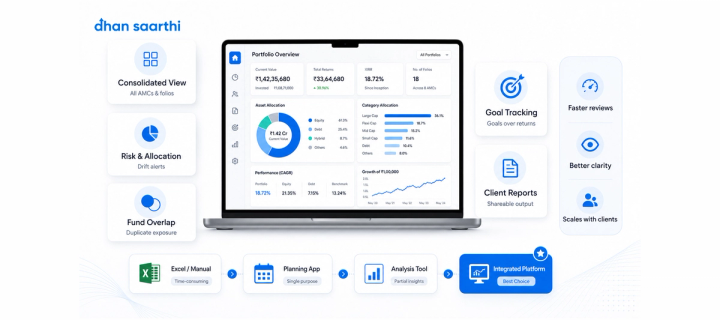
Dhan Saarthi is built specifically for Mutual Fund Distributors, sub-distributors, and ARN holders who need a structured, advisor-first way to monitor client portfolios at scale. Rather than pulling data from multiple AMC portals and assembling it manually, the platform gives you a consolidated view of every client's portfolio in one place — so the 5-point health scan described in this article takes minutes, not an afternoon.
- 1. Consolidated portfolio view — all client folios and AMCs in a single dashboard, updated so you always have current data before a review.
- 2. SIP tracking — instantly see which SIPs are active, lapsed, or recently cancelled across your entire book without checking individual AMC accounts.
- 3. Automatic XIRR calculation — portfolio XIRR is computed for each client without manual effort, giving you the return picture you need for every health scan.
- 4. Asset allocation visibility — view current equity-to-debt split for each client against their target allocation, so drift is visible at a glance.
- 5. Client-ready reports — generate a clean, shareable portfolio summary for clients flagged amber or red, without building it from scratch each time.
For Mutual Fund Distributors managing 50 to 500 clients, Dhan Saarthi removes the data-assembly bottleneck that makes consistent health checks impractical — so you can focus your review time on judgment and conversations, not spreadsheet work.
Conclusion
Portfolio health checks are the operational core of client retention, not a luxury — the Mutual Fund Distributors who review consistently are the ones who catch problems early and retain business that would otherwise drift away quietly. The system here — traffic-light sorting, a 5-point scan, tiered review frequency, and a defined action protocol — is scalable without needing a full day or a large team; it just takes discipline, a fixed weekly time block, and the right data at your fingertips. Start with your highest-value clients, build the habit, then expand it to your entire book.