Choosing portfolio review software isn't a checklist decision — it's a decision that shapes how many clients you can genuinely serve, how professional your reviews look, and how much time is actually left for client conversations. This guide breaks down what portfolio review software should do, the types of tools available, and what to check before you commit to one.
Why the Tool You Use for Portfolio Review Actually Matters
A portfolio review is one of the few moments a client actively pays attention to what you do. It's where trust is either reinforced or quietly eroded. A review built on scattered statements, manual calculations, and a rushed conversation feels different from one backed by a clear, consolidated view of the client's holdings.
For a Mutual Fund Distributor managing a growing client book, the software behind the review matters more than it seems. It decides how many clients you can review properly in a month, how consistent your review quality is across clients, and whether a review takes twenty minutes or two hours to prepare.
This isn't about chasing the flashiest tool. It's about picking software that matches how you actually work — and that holds up as your client book grows.
Why this matters to your practice: The wrong tool doesn't just cost you time — it caps how many clients you can serve well. Practices that outgrow their review process usually don't notice until review quality has already started slipping.
Below is what to actually look for — starting with what portfolio review software needs to do, not what it claims to do.
What Should Portfolio Review Software Actually Do?
Capability 01
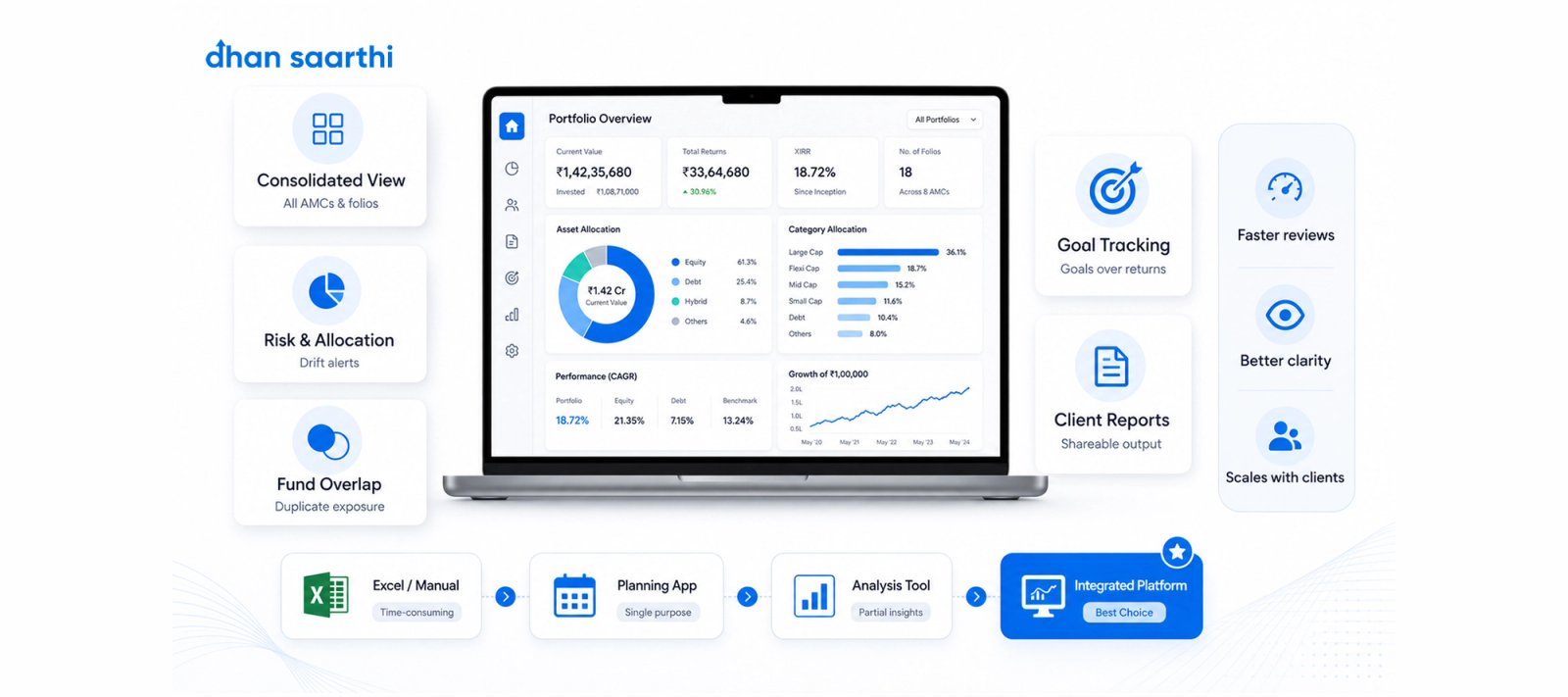
A Consolidated View Across AMCs and Folios
Most clients hold folios across multiple AMCs, often opened at different points in time. Software that shows these as one consolidated portfolio — instead of separate statements you have to mentally combine — is the baseline requirement, not a bonus feature.
Why it matters
Without consolidation, every review starts with manual assembly work. That's time you're not spending on the actual conversation with the client.
Capability 02
Asset Allocation and Risk Health Checks
A portfolio can look fine at the fund level and still be badly misaligned at the allocation level. Good software should flag when a client's actual allocation has drifted from what their risk profile and goals call for.
Why it matters
Allocation drift is one of the easiest things to miss manually across a large client book — and one of the easiest to explain to a client once it's visible.
Capability 03
Fund Overlap and Over-Diversification Detection
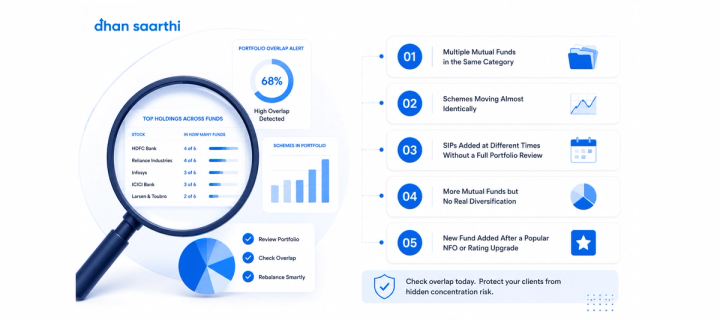
Clients who've invested over several years, often across advisors or on their own, tend to accumulate funds with overlapping holdings. Software that surfaces this overlap gives you a concrete, specific talking point instead of a vague "let's simplify your portfolio" suggestion.
Why it matters
Specific findings build more credibility than general observations. "You're holding four funds with similar large-cap exposure" lands very differently than "your portfolio could be cleaner."
Capability 04
Goal-Linked Tracking, Not Just Returns
A review that only shows returns invites a returns-only conversation. Software that ties holdings back to the client's actual goals keeps the conversation anchored to something more durable than short-term performance.
Why it matters
Goal-linked reviews are harder to unsettle during volatile markets, because the conversation isn't only about whether a number went up or down.
Capability 05
Client-Ready Reports, Not Raw Data
A dashboard that only makes sense to you isn't a finished tool. The output a client actually sees should be clean, simple, and shareable — something that reflects the quality of the work, not a raw export.
Why it matters
A polished report is also a quiet trust signal. It tells the client the review was thorough, even before they've read a single line of it.
Types of Portfolio Review Tools Mutual Fund Distributors Use Today
Most Mutual Fund Distributors fall into one of four setups for portfolio review. Each works to a point — the question is how well it holds up as your client book grows.
| Tool Type | Effort Required | Client-Readiness | Scales Well? |
|---|---|---|---|
| Manual tracking (Excel / Google Sheets) | High — updated and built by hand | Low — raw and inconsistent | Poor |
| Generic financial planning apps | Medium — not built for advisor workflow | Medium — often built for self-use | Limited |
| Standalone portfolio analysis tools | Medium — good analysis, disconnected from client workflow | Medium to high | Limited |
| Integrated advisor platforms (review + client management together) | Low, once set up | High — built for the client-facing conversation | Strong |
💡 Manual tracking usually feels manageable up to a small client book. The gap tends to show up quietly — reviews start taking longer, get postponed, or get done with less depth than they used to.
Checklist: What to Check Before Choosing Portfolio Review Software
Before you commit to any tool, run it against this checklist. A tool that fails more than one or two of these isn't wrong — it's just not built for how a growing practice actually operates.
- ✓ Does it consolidate holdings across AMCs and folios automatically, without manual entry?
- ✓ Does it flag allocation drift and fund overlap, or leave that analysis to you?
- ✓ Can it link portfolios back to individual client goals, not just show returns?
- ✓ Does it produce a report you'd be comfortable sharing directly with a client?
- ✓ Can it handle your entire client book, not just a handful of test accounts?
- ✓ Does it show you which clients are overdue for a review, so nothing gets missed?
How Dhan Saarthi Helps With Portfolio Review
Most of the checklist above breaks down at scale. It's manageable for ten clients and genuinely difficult for a hundred and fifty, especially when every review still involves pulling data manually and building the output from scratch each time.
Dhan Saarthi is built to close that gap for Mutual Fund Distributors. Here's what that looks like in practice:
- ✓ Consolidated portfolio view. See a client's full holdings across AMCs and folios in one place, without assembling separate statements.
- ✓ Allocation and risk flags. Spot when a client's actual allocation has drifted from their risk profile, before it becomes a bigger conversation.
- ✓ Fund overlap detection. Get specific, portfolio-level findings you can bring into the review conversation, instead of general observations.
- ✓ Goal-linked tracking. Keep every portfolio tied back to the client's actual goal, so reviews stay anchored beyond short-term returns.
- ✓ Client-ready reporting. Generate a clean, shareable review output for each client without building it manually every time.
The goal is simple: give you a review process that holds up whether you're serving twenty clients or two hundred, without asking you to trade depth for speed.
See Portfolio Review Software Built for Mutual Fund Distributors
Request a demo and see how Dhan Saarthi consolidates portfolio review across your entire client book.
Request a DemoIn Short
There's no single "best" portfolio review software in the abstract — there's the software that fits how your practice actually operates today, and holds up as it grows. Manual tracking works until it doesn't. Generic tools go part of the way. What actually closes the gap is software built specifically around how a Mutual Fund Distributor reviews, reports, and stays on top of an entire client book — not just one portfolio at a time.
Use the checklist above as your baseline the next time you evaluate a tool. If it can't consolidate, flag, and report clearly, it's not going to save you the time it promises.