Most Mutual Fund Distributors don't have a client acquisition problem. They have a leverage problem. The same book of clients, the same referral potential, and the same trust already built are sitting underused. This guide lays out five growth levers that don't depend on luck, cold outreach, or spending on ads — and a practical way to track them.
Why Mutual Fund Business Growth Stalls Even for Good Distributors
Ask most Mutual Fund Distributors how they plan to grow, and the answer is usually "more clients." That's not wrong, but it's incomplete. Chasing new clients while existing ones quietly disengage, refer no one, and use only a fraction of the services on offer is growth with a leak in it.
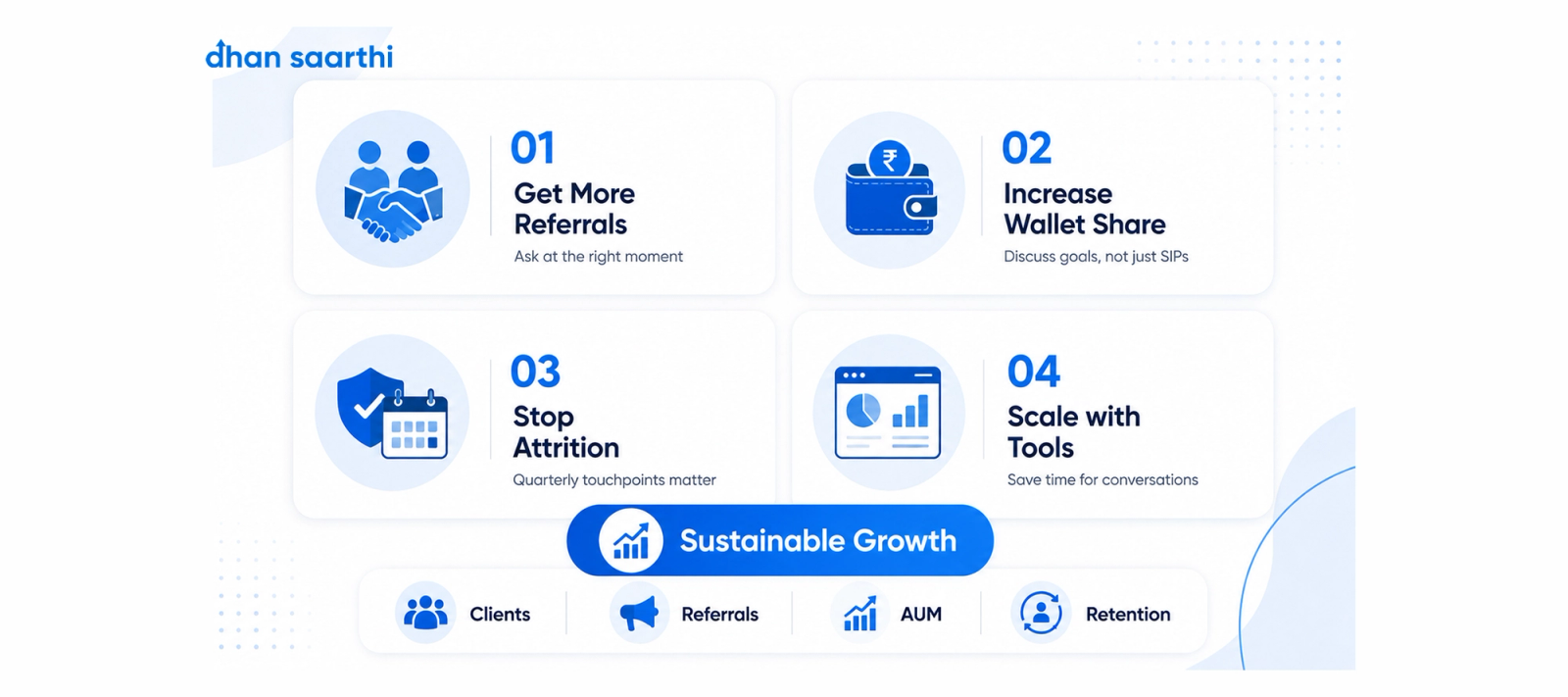
Sustainable growth in Mutual Fund distribution business comes from four things working together: new client acquisition, referral generation, wallet share within existing clients, and retention. Most Distributors are strong on one or two of these and weak on the rest — usually without realising it.
The good news is that the highest-leverage growth actions are also the ones already sitting closest to hand: the clients you already serve, the trust you've already earned, and the visibility you haven't yet built around it.
Why this matters to your practice: A business that only grows through new client acquisition is also the most expensive to grow and the most fragile — every client lost has to be replaced from scratch. A business that also grows through referrals, retention, and wallet share compounds instead of resetting every year.
Below are five growth levers — with a practical action for each — that Mutual Fund Distributors can apply regardless of the size of their current book.
Five Growth Levers Every Mutual Fund Distributor Should Be Using
Lever 01
How to Get More Referrals From Existing Clients
Most satisfied clients don't refer — not because they're unwilling, but because no one asked them at the right moment, in the right way. A vague "let me know if anyone needs help" rarely produces a referral. It puts the entire burden of remembering, connecting the dots, and making the introduction on the client.
Referrals happen most naturally right after a client experiences clear value — a goal reached, a portfolio review that reassured them, a market-fall conversation that calmed their nerves. That window closes quickly if it isn't used.
Action Step
Build a habit of asking for a specific introduction — not a general referral — right after a positive client moment. Instead of "do you know anyone who needs a Mutual Fund Distributor," try "is there someone in your family or close circle who's been putting off getting their investments organised?" A specific ask is easier for the client to act on than an open-ended one.
Lever 02
How to Increase Wallet Share Without Adding a Single New Client
Many Mutual Fund Distributors only see a fraction of a client's total investable wealth. The rest sits in fixed deposits, insurance-linked products, a separate demat account, or with another Distributor entirely — often because the client was never asked a broader question than "how much do you want to invest this month?"
Goal-based conversations naturally surface this. A client planning for a child's education, a home, or retirement rarely thinks about it in terms of a single SIP — they think about it as a life goal that different pieces of their finances are meant to serve.
Action Step
During annual reviews, ask about goals rather than only performance: "Is there anything coming up in the next 2–3 years — a large expense, a change in income, a new goal — that we should plan the portfolio around?" This one question routinely uncovers investable money the client hadn't mentioned, simply because no one had asked.
Lever 03
How to Build a Local Digital Presence Clients Can Actually Find
A large share of new clients now research a Distributor online before the first conversation even happens — checking a Google search, a WhatsApp Business profile, or asking mutual connections. A Distributor with no discoverable digital presence is invisible to exactly this group, no matter how strong their in-person reputation is.
This doesn't require a large marketing budget. It requires being findable and credible in the places a prospective client is already looking.
Action Step
Set up (or clean up) a Google Business Profile, a WhatsApp Business profile with clear service details, and share simple, genuinely useful content — a monthly market note, a goal-planning explainer, a client FAQ — instead of promotional posts. Consistency matters more than volume: a short monthly update sustained over a year builds more credibility than a burst of posts that stops after a month.
Lever 04
How to Stop Client Attrition From Quietly Eating Into Growth
Growth isn't only about what comes in — it's also about what stops leaving. A Distributor who adds new clients every year but loses a similar number to disengagement, poor communication, or a competing Distributor is running in place, not growing.
Client attrition is rarely sudden. It follows a pattern: reduced engagement, fewer questions, silence during market volatility, and eventually a request to redeem or move the portfolio elsewhere. By the time that request arrives, the relationship has usually been slipping for months.
Action Step
Build a review cadence you actually follow — at minimum, one proactive touchpoint per client per quarter, and a portfolio review at least once a year. Prioritise the clients you haven't spoken to in the longest time; they carry the highest attrition risk, even if their portfolios look fine on paper.
Lever 05
How to Scale Your Mutual Fund Business Without Losing the Personal Touch
There's a point in every growing practice where manual tracking — spreadsheets, memory, scattered notes — starts to break down. Reviews get delayed, at-risk clients get missed, and the personal attention that built the business in the first place gets diluted simply because there isn't enough time in the day.
The Distributors who scale successfully don't do it by working longer hours. They do it by using tools that handle the repetitive tracking, so their time goes into the conversations that actually need a human — the ones that build trust and drive referrals.
Action Step
Audit where your time goes for one week. Anything that's repetitive tracking — SIP status, review due dates, portfolio health checks — is a candidate to move to a tool. Anything that's a conversation with a client is where your personal time should stay.
Your Mutual Fund Business Growth Checklist
Knowing the five levers is useful. Tracking them consistently across a growing client book is what actually turns them into growth.
Below is a simple way to structure this, regardless of the size of your current practice.
| Growth Lever | What to Track | Review Frequency | Priority |
|---|---|---|---|
| Referral generation | Referrals asked for vs. received, by client | After every positive client moment | High |
| Wallet share per client | Goals discussed vs. goals actually funded | Annual review | Medium |
| Digital discoverability | Google Business Profile, WhatsApp Business, content cadence | Monthly | Medium |
| Client attrition risk | Days since last client touchpoint | Quarterly, per client | High |
| Time spent on manual tracking | Hours per week on admin vs. client conversations | Once, then reassess quarterly | Medium |
💡 Growth compounds when acquisition, referrals, wallet share, and retention are worked on together — not one at a time. A practice that only focuses on new client acquisition, for instance, will keep growing the top of the funnel while quietly losing clients from the bottom.
Three non-negotiable habits for sustainable growth
- ✓ Ask for a specific referral after every positive client moment — don't leave it to chance or to the client to remember.
- ✓ Review every client's full financial picture at least once a year, not just the mutual fund portfolio you can already see.
- ✓ Track engagement across your entire client book, not just the largest accounts — attrition risk often starts with the clients you check on least.
How Dhan Saarthi Helps You Grow Your Mutual Fund Business
Every lever above is straightforward in principle and hard to sustain manually once a practice grows beyond a handful of clients. Referral moments get missed because there's no system to flag them. Goal conversations don't happen because there's no easy way to see which clients haven't had one recently. Attrition risk builds up quietly because there's no single view of who's gone silent.
Dhan Saarthi is built to close these gaps for Mutual Fund Distributors. Here's what that looks like in practice:
- ✓ A single view of your entire client book. See engagement, review status, and portfolio health across all your clients in one place, instead of piecing it together from memory and spreadsheets.
- ✓ Portfolio health analysis. Quickly identify clients whose portfolios need attention or a goal-based conversation, so wallet-share opportunities don't get missed.
- ✓ Review and touchpoint tracking. Know exactly which clients haven't had a review or check-in recently, so you can prioritise outreach before disengagement turns into attrition.
- ✓ Structured client reporting. Share clear, professional portfolio updates that reinforce your value and give clients a natural reason to talk about you to others.
The goal is simple: give you back the time these growth levers need, without adding to your workload.
See How Dhan Saarthi Can Support Your Growth
Get a walkthrough of how Dhan Saarthi helps Mutual Fund Distributors track client engagement, portfolio health, and growth opportunities in one place.
Request a Dhan Saarthi DemoConclusion
Growing a Mutual Fund business isn't about finding one big breakthrough. It's about consistently working four levers that reinforce each other — asking for referrals at the right moments, uncovering wallet share through goal-based conversations, building a digital presence clients can find, and protecting the book you already have from quiet attrition.
None of this requires a large team or a big budget. It requires consistency, and a system that makes it easy to see where your attention is needed next — which is exactly the gap tools like Dhan Saarthi are built to close.