Last updated: 5 November 2026 · By Mahak Jain
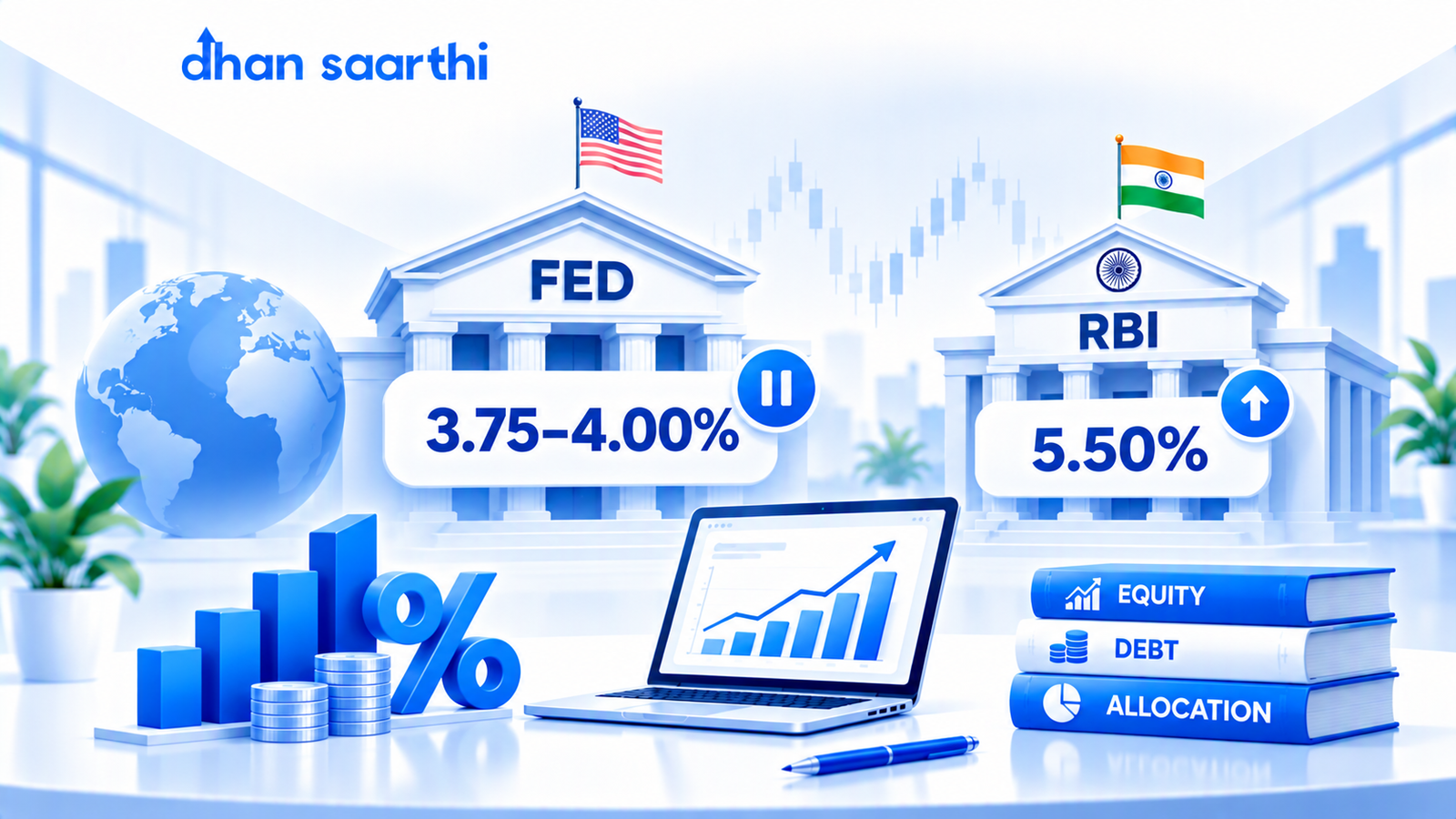
Quick answer: On 28 October 2026 the US Federal Reserve held its policy rate at 3.75%–4.00%, after raising it by 0.25% in September. The vote was 10–2, and both dissenters wanted another hike, not a cut. With US growth at 3.4% and the RBI also tightening, MFDs should not tell clients that rate cuts are coming. Review debt-fund duration, asset allocation and horizon instead of reacting to the Fed.
3.75–4%
Fed funds target range
10–2
vote; 2 wanted a hike
3.4%
US Q3 GDP, annualised
5.50%
RBI repo after 7 Oct hike
| Key fact | Value |
|---|---|
| Fed decision, 28 October 2026 | Held the federal funds target range at 3.75%–4.00% |
| Vote | 10–2. Lisa D. Cook and Beth M. Hammack preferred a 0.25% increase |
| Previous move, 16 September 2026 | Raised by 0.25% to 3.75%–4.00%, 12–0 vote |
| Fed's view of inflation | "Inflation remains elevated" |
| Interest on reserve balances / discount rate | 3.90% / 4.00%, unchanged |
| US real GDP, July–September 2026 | 3.4% annualised (2.2% in April–June), advance estimate |
| US PCE inflation, Q3 2026 | 2.1% annualised (core 2.5%), down from 5.0% (core 3.3%) in Q2 |
| US 10-year Treasury yield | 4.94% on 30 October, from 5.00% on 23 October |
| RBI repo rate, 7 October 2026 | Raised 0.25% to 5.50%; stance 'calibrated tightening' |
| Next decisions | RBI MPC: 2–4 December 2026. Fed FOMC: 8–9 December 2026 |
Sources: Federal Reserve FOMC statement, implementation note, September statement, US BEA, US Treasury and RBI. Checked on 5 November 2026.
What did the Fed decide on 28 October 2026?
The Federal Open Market Committee (FOMC) kept the federal funds target range at 3.75%–4.00%. Its statement says economic activity is expanding at a strong pace, domestic spending has been resilient and job gains have kept pace with the workforce. It also says inflation remains elevated.
The Fed said it will gather more information before deciding the policy stance needed to bring inflation back to its 2% goal. In plain terms: it is waiting, not easing.
Two officials wanted a hike
The vote was 10–2. Lisa D. Cook and Beth M. Hammack dissented. Both wanted to raise the range by another 0.25%. No member voted for a cut.
This pause follows a hike
On 16 September 2026 the Fed raised rates by 0.25%, in a 12–0 vote, to the current range. October's hold is a pause in a tightening cycle, not a turn toward cuts.
| Meeting | Decision | Range after | Vote |
|---|---|---|---|
| 16 September 2026 | Hike, +0.25% | 3.75%–4.00% | 12–0 |
| 28 October 2026 | Hold | 3.75%–4.00% | 10–2 (two wanted +0.25%) |
| 8–9 December 2026 | Next meeting, with new projections | – | – |
Why is US growth making rate cuts harder?
The US Bureau of Economic Analysis (BEA) advance estimate, released on 29 October, shows real GDP grew at an annualised 3.4% in July–September, up from 2.2% in April–June. Investment, consumer spending and government spending rose. Real final sales to private domestic buyers grew 4.9%.
Strong demand gives the Fed less reason to cut. If spending stays firm while inflation is elevated, rates can stay high for longer.
Read the numbers correctly
- ✓ 3.4% is annualised: it is the quarter's growth scaled to a yearly pace (0.8% for the quarter), not year-on-year growth.
- ✓ It is an advance estimate: the BEA's second estimate is due on 25 November 2026 and can revise it.
- ✓ Quarterly inflation eased: the PCE price index rose 2.1% annualised in Q3 (core 2.5%), down from 5.0% in Q2. The Fed still calls inflation elevated, so one softer quarter has not changed its stance.
How does the Fed affect Indian markets and mutual funds?
US rates set the price of money worldwide. When they stay high, the effects reach India through four channels:
- ✓ Foreign flows: higher US yields make US bonds more attractive, which can pull foreign portfolio money out of emerging-market equities. Daily FPI data is on NSDL.
- ✓ Rupee: a strong dollar and outflows can weaken the rupee, which raises the cost of imports such as crude oil.
- ✓ Bond yields: the US 10-year Treasury yield was 4.94% on 30 October (US Treasury). High global yields limit how far Indian yields can fall.
- ✓ Equity valuations: higher rates lower the present value of future earnings, which weighs most on richly valued stocks.
The RBI is tightening too
The RBI raised the repo rate by 0.25% to 5.50% on 7 October 2026 and moved to a 'calibrated tightening' stance. Its policy statement cites the Fed's September hike, global bond yields at record highs and volatile crude oil prices. It says rate cuts are "off the table in the near term"; the next move can only be a hike or a pause.
So neither the Fed nor the RBI is signalling cuts. That matters most for debt-fund clients who are waiting for rate cuts to lift returns.
| Fund type | How 'higher for longer' can affect it | What to check |
|---|---|---|
| Large, flexi and multi cap | Pressure on valuations and foreign flows; earnings still matter more over time | Is equity exposure in line with the plan? |
| Mid and small cap | More sensitive to tighter liquidity and risk appetite | Does the horizon support this exposure? |
| Long-duration debt and gilt funds | Yields may stay high or rise, so NAVs can fall in the short term | Does duration match when the money is needed? |
| Short-duration, money market and liquid funds | Benefit from higher short-term yields; little price risk | Suitable for near-term goals and emergency money |
| International (US) funds | A strong dollar can lift rupee returns; US equities face rate pressure too | Overseas limits, taxation and concentration |
Illustrative and educational only. Not a recommendation to buy, sell or switch any scheme.
What should MFDs tell clients about the Fed decision?
The common question: "The Fed paused. Will rates fall now? Should I move money into long-term debt funds?" A clear reply:
"The Fed paused, but it did not cut, and two members wanted another hike. The RBI has also said cuts are off the table for now. So we should not invest on the hope of rate cuts. Let's keep your debt funds matched to when you need the money, and keep your equity mix in line with your goals."
Then run a short review, client by client:
- Asset allocation: check whether the equity–debt split has drifted from the target. Rebalance to the plan.
- Debt duration: money needed within 1–3 years belongs in short-duration, money market or liquid funds, not long-duration funds bought for a rate-cut bet.
- Horizon and liquidity: confirm when each goal falls due and how quickly the client may need cash.
- SIP continuity: keep SIPs running through rate uncertainty unless goals have changed. See our guide to preventing SIP cancellations.
What not to say
- ✕ Do not say "rate cuts are coming". Both the Fed and the RBI are in tightening mode.
- ✕ Do not treat a pause as a signal. The next Fed decision on 9 December could be a hold or a hike.
- ✕ Do not predict the rupee or FPI flows. Explain the channels; avoid forecasts you cannot stand behind.
For structure, use our client review meeting framework and goal-based conversation scripts.
Dates MFDs should watch
| Event | Date | Why it matters |
|---|---|---|
| US GDP second estimate (BEA) | 25 November 2026 | Confirms or revises the 3.4% growth figure |
| RBI MPC decision | 2–4 December 2026 | Hike or pause; affects Indian bond yields and debt funds |
| Fed FOMC decision, with new projections | 8–9 December 2026 | Shows whether officials expect more hikes in 2027 |
Sources: BEA, RBI and Federal Reserve calendar.
Turn a rate headline into a client review
Run portfolio health checks and share client reports from one platform. Khazana Fintech Pvt. Ltd., AMFI ARN-325085.
Book a Demo with Dhan SaarthiSources
- Federal Reserve: FOMC statement, 28 October 2026
- Federal Reserve: Implementation note, 28 October 2026
- Federal Reserve: FOMC statement, 16 September 2026
- Federal Reserve: FOMC meeting calendars
- US Bureau of Economic Analysis: GDP (advance estimate), 3rd quarter 2026, 29 October 2026
- US Department of the Treasury: Daily Treasury par yield curve rates, October 2026
- Reserve Bank of India: Monetary Policy Statement, 7 October 2026
- NSDL: Daily trends in FPI investments
Disclaimer: This article is for investor education and distributor communication only. It is not investment advice or a recommendation to buy, sell or hold any scheme. Data is as of the dates stated and can change. Distribution services are offered through Khazana Fintech Pvt. Ltd. (Dhan Saarthi), AMFI-registered Mutual Fund Distributor, ARN-325085. Mutual fund investments are subject to market risks; read all scheme-related documents carefully. Past performance is not indicative of future returns.