Last updated: 13 November 2026 · By Mahak Jain
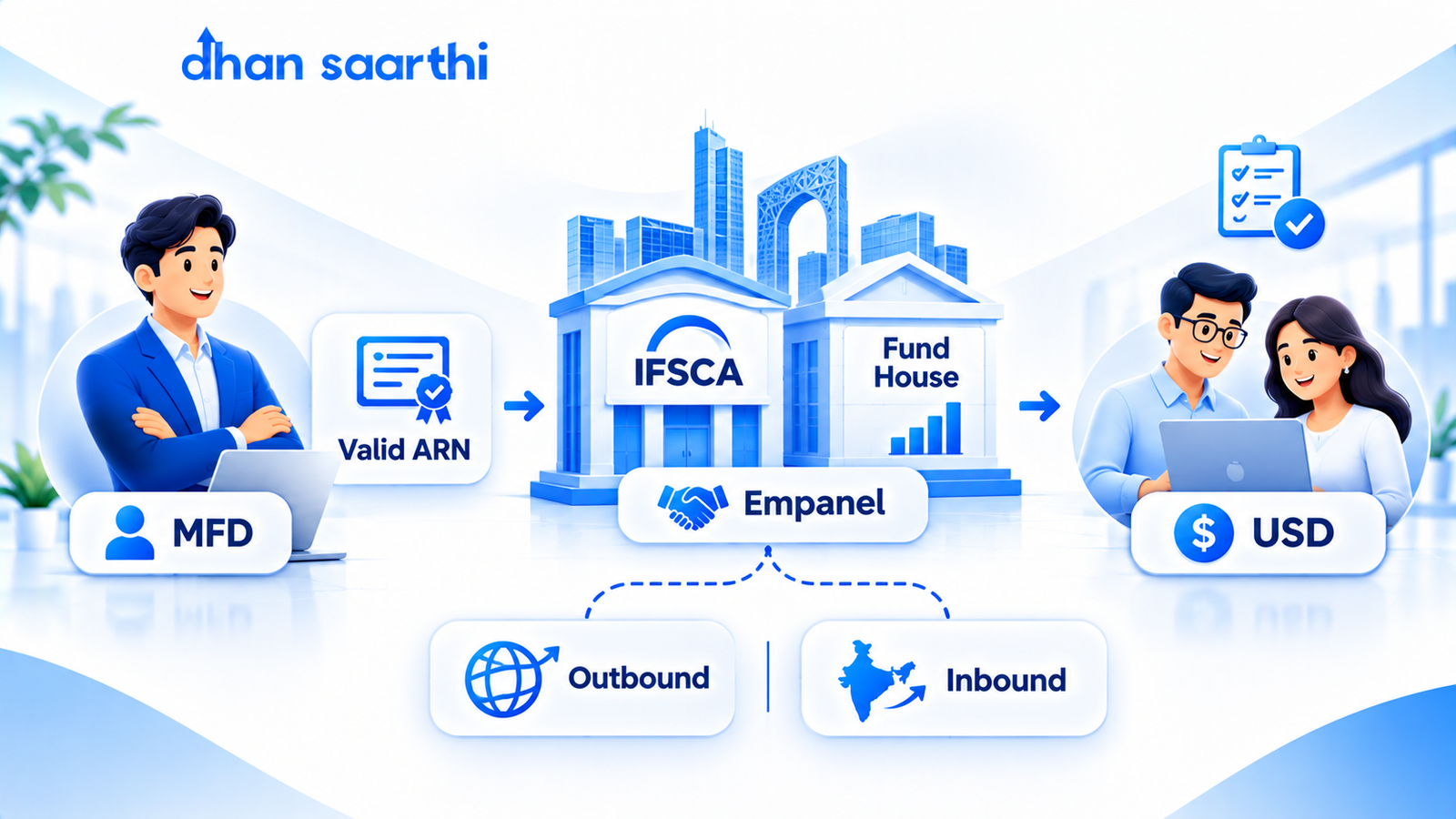
Quick answer: To distribute GIFT City funds, you do not need an office in GIFT City or a separate IFSCA licence. With a valid ARN, you empanel with each GIFT City fund house (called a Fund Management Entity, or FME) that you want to sell. Then you match the right fund to the right client: resident Indians can buy only outbound funds (which invest abroad) through LRS, while NRIs and foreign investors can buy inbound funds (which invest in India). All investments are in US dollars, and the fund house pays you commission under its own distributor terms.
| Key fact | Value |
|---|---|
| Regulator | IFSCA (International Financial Services Centres Authority), not SEBI |
| Rules for the funds | IFSCA (Fund Management) Regulations, 2025 |
| Who can distribute | An AMFI-registered MFD (valid ARN) empanelled with the GIFT City fund house |
| Need an office in GIFT City? | No, not for empanelment. Only a separate IFSCA distributor registration needs one |
| Empanelment fee | Usually nil. DSP, for example, charges no fee to empanel |
| Resident Indian clients | Outbound funds only, through LRS (up to USD 2,50,000 per person per financial year) |
| NRI / foreign clients | Inbound funds (Indian markets) and outbound funds, from a foreign bank account |
| Currency | US dollars only |
| Typical retail minimum | USD 500 to USD 5,000 for most outbound retail funds (October 2026) |
| TCS on remittance | 20% on LRS investment remittances above ₹10 lakh a year; claimable in the ITR |
| Where to find GIFT City funds | Dhan Saarthi GIFT City explorer: browse and compare GIFT City funds |
Minimums, fees and commission terms change often and differ by fund house. Check the latest scheme document before you advise a client.
What are GIFT City funds?
GIFT City (Gujarat International Finance Tec-City) in Gandhinagar is India's International Financial Services Centre (IFSC). Legally, it is treated as foreign territory for money matters. Funds set up there are run by Indian AMCs and global managers, but they are regulated by IFSCA and transact in US dollars.
For a distributor, every GIFT City fund falls into one of two buckets:
| Outbound fund | Inbound fund | |
|---|---|---|
| Invests in | Global markets (US, developed, emerging, China etc.) | Indian markets |
| Who can invest | Resident Indians (via LRS), NRIs, foreign investors | NRIs and foreign investors only |
| Why clients buy it | Global diversification in dollars, without an offshore broker | India exposure in dollars, with simpler KYC and tax filing |
| Examples (October 2026) | PPFAS IFSC S&P 500 and Nasdaq 100 FoFs, HDFC International funds, DSP Global Equity, JioBlackRock World Equity | India equity and debt funds from several AMCs' IFSC arms |
Besides retail mutual fund–style schemes, GIFT City also has PMS (typically from USD 75,000) and AIFs (around USD 1,50,000). This guide focuses on retail funds, which suit most MFD clients.
Can a mutual fund distributor sell GIFT City funds?
Yes. An Indian MFD can distribute GIFT City funds by tying up directly with the IFSCA-registered fund house. You do not need to be physically present in GIFT City (Cafemutual). The fund house is responsible for checking its distributors.
Two things change compared with your regular mutual fund business:
- ✓ Your ARN is the entry ticket, not the licence. The fund house uses your ARN and PAN to verify you. The sale itself happens under IFSCA rules.
- ✓ You follow IFSCA's code of conduct for distributors. That means suitability, disclosure of commission and no misleading claims, much like AMFI's code.
How to distribute GIFT City funds: 5 steps
Keep your ARN and NISM certification valid
Fund houses check your ARN against the AMFI database. A lapsed ARN or expired NISM V-A certificate will block empanelment.
Pick the GIFT City fund houses you want to work with
List which funds your clients actually need: a US index FoF, a global equity fund or an India fund for NRIs. You can browse and compare them on the Dhan Saarthi GIFT City page. Empanel only with those FMEs first.
Empanel with each fund house
Most have an online form. DSP GIFT City, for example, verifies your ARN and PAN online, with no fee. Sign the distributor agreement and note the commission schedule (it is set in USD terms).
Onboard the client and complete KYC
The fund house runs its own KYC. Resident clients need PAN and Aadhaar-based KYC; NRIs usually need a passport and address proof. Some fund houses still ask for signed physical forms, so check the process before you promise a timeline.
Help the client fund the investment in USD
Resident clients remit through their bank under LRS (Form A2). NRIs pay from a foreign bank account. Once units are allotted, track the holding and review it with the client's Indian portfolio.
Do you need to register with IFSCA to distribute GIFT City funds?
Not for most MFDs. There are two routes, and the first is enough for an individual distributor:
| Route 1: Empanel with fund houses | Route 2: Register as an IFSC distributor | |
|---|---|---|
| Who uses it | Individual and small MFD firms | Banks, wealth firms, large distributors |
| Office in GIFT City | Not required | Required |
| Net worth | No requirement | USD 50,000 (as reported by Cafemutual) |
| Fees | Usually nil | Registration and annual fees to IFSCA |
| Compliance | Fund house checks you; IFSCA code of conduct applies | Principal officer and compliance officer in IFSC |
Start with Route 1. Move to Route 2 only if GIFT City becomes a large, separate line of business for you.
Which clients can invest in GIFT City funds?
Resident Indians
A resident individual with a PAN can invest in outbound GIFT City funds under the RBI's Liberalised Remittance Scheme (LRS). The limit is USD 2,50,000 per person per financial year, shared with all other foreign remittances such as travel and education. Residents cannot invest in inbound funds.
NRIs and foreign investors
NRIs can invest in both inbound and outbound funds. They pay from a foreign bank account, in dollars, without routing money through an NRE or NRO account. Some funds exclude investors from certain countries (often the US and Canada), so check eligibility in the offer document.
Who it suits, and who it does not
- ✓ Clients who want global equity in dollars and already hold a solid Indian core portfolio.
- ✓ Clients with dollar goals, such as a child's foreign education.
- ✓ NRIs who want India exposure without the paperwork of NRE/NRO accounts.
- ✕ Small first-time investors. The USD 500–5,000 minimum, currency risk and TCS make it a poor first product.
- ✕ Clients who need regular SIPs. Most GIFT City retail funds take lump sums only for now.
- ✕ Money needed in the short term. Currency moves can cut returns over short periods.
How does a resident Indian invest in a GIFT City fund?
- Choose the outbound fund and confirm the minimum (often USD 500 or USD 5,000).
- Complete KYC with the fund house using PAN and Aadhaar. Many now do this online.
- Remit dollars under LRS through the client's bank with Form A2, to the fund's collection account in GIFT City.
- Pay TCS if needed. Investment remittances above ₹10 lakh in a financial year attract 20% TCS on the amount above ₹10 lakh. It is not a cost: the client adjusts it against income tax in the ITR.
- Units are allotted in USD and the holding must be shown as a foreign asset (Schedule FA) in the client's tax return.
Example: a client remits ₹15 lakh in one year. TCS applies on ₹5 lakh (the part above ₹10 lakh), so ₹1 lakh is collected and later claimed back in the ITR. Illustration only.
How much commission do distributors earn on GIFT City funds?
Each GIFT City fund house sets its own distributor commission in its agreement. AMFI's trail-only rules for Indian schemes do not decide these payouts; IFSCA rules and the fund house's terms do.
For a rough idea: in 2024, some fund houses offered upfront plus trail commission on GIFT City AIFs, or an all-trail option of around 1.35% a year (Cafemutual). Retail outbound funds usually have lower expense ratios, so trail is smaller. Ask each fund house for its current schedule before you pitch.
Commission is earned in USD terms and paid as per the agreement. Disclose it to the client, just as you would for Indian mutual funds.
How are GIFT City funds taxed?
Tax depends on the client's residency and the fund's structure, so keep this part simple and point clients to the fund's tax note:
| Client | What to tell them |
|---|---|
| Resident Indian (outbound fund) | Gains are taxable in India. Many funds treat units held over 24 months as long-term (12.5%) and shorter holdings at slab rate. Some funds pay tax at fund level instead. Declare the holding in Schedule FA every year. |
| NRI (inbound fund) | Specified IFSC funds give non-residents exemptions under Section 10(4D). Tax in their country of residence may still apply. |
| TCS on LRS remittance | 20% above ₹10 lakh a year. Adjustable against tax payable or refunded through the ITR. |
Tax rules for IFSC funds differ across schemes and have changed in recent budgets. Ask the client to confirm with their CA before investing.
GIFT City funds vs international mutual funds in India: which is better for clients?
| GIFT City outbound fund | Indian international fund / FoF | |
|---|---|---|
| Currency | USD | INR |
| Counts towards LRS limit | Yes | No |
| TCS | Yes, above ₹10 lakh a year | No |
| Minimum | Usually USD 500–5,000 | ₹100–₹5,000 |
| SIP | Mostly lump sum | Yes, when the AMC is within RBI's overseas limit |
| Fresh inflows | Open | Often paused when the industry's overseas investment limit is hit |
| How you sell it | Empanel with each FME | Your existing AMC empanelment |
Use Indian international funds for small, regular global SIPs. Use GIFT City outbound funds for larger lump sums, dollar goals, or when Indian international funds have stopped fresh money.
Common mistakes to avoid when selling GIFT City funds
- ✕ Selling inbound funds to residents. Residents can buy only outbound funds.
- ✕ Ignoring the client's LRS usage. Travel and education remittances use the same USD 2,50,000 limit.
- ✕ Calling TCS a cost. It is advance tax that the client gets back or adjusts. Explain it up front.
- ✕ Forgetting Schedule FA. Missing foreign asset disclosure can draw penalties under the Black Money Act.
- ✕ Promising rupee returns. Returns are in USD; the rupee value moves with the exchange rate.
- ✕ Assuming one empanelment covers all. Each fund house needs its own agreement.
Grow your advisory business with Dhan Saarthi
Explore GIFT City funds, manage clients, run portfolio health checks and build proposals across mutual funds and SIFs from one platform. Khazana Fintech Pvt. Ltd., AMFI ARN-325085.
Book a Demo with Dhan SaarthiSources
- IFSCA: Fund Management Regulations, 2025 (as amended up to 10 September 2026)
- IFSCA: Master Circular for Distributors in IFSC (5 August 2025)
- RBI: Liberalised Remittance Scheme FAQs
- Cafemutual: MFDs can distribute IFSC products without setting up office in GIFT City (August 2024)
- Cafemutual: Opportunities for MFDs in GIFT City (June 2024)
- DSP GIFT City: Distributor empanelment
Disclaimer: This article is for distributor education only. It is not investment, tax or legal advice, or a recommendation to buy any scheme. GIFT City funds are regulated by IFSCA and involve currency risk. Rules, minimums, tax and commission terms are as of the dates stated and can change. Distribution services are offered through Khazana Fintech Pvt. Ltd. (Dhan Saarthi), AMFI-registered Mutual Fund Distributor, ARN-325085. Mutual fund investments are subject to market risks; read all scheme-related documents carefully.